In this guide
This guide walks through it in the order that actually matters: how solar generates power, whether that means you need a battery, what we check before recommending a size, what compliance requires, and how you can pay for it. No fluff, no oversized systems you don’t need.
A Sollar battery is worth considering if your solar panels produce more electricity tha you use during the day and your household consumes most of its energy in the evening. Instead of exporting excess solar power to the grid at low feed-in tariff rates, a battery stores that energy for later use.
How Solar Actually Works, Day to Day
Your solar panels generate electricity whenever there’s daylight on them, rising to a peak around midday and tapering off by evening. Over a full day, generation adds up to a total measured in kilowatt-hours (kWh) — the same unit as your bill. A typical Perth home system might generate 20–30 kWh on a good day.
Here’s the part that matters: your panels don’t know what time you do your washing, run the aircon, or cook dinner. They produce power whenever the sun is up. Your household peaks in the evening, when the sun has gone down.
What Happens to the Solar Power You Don’t Use
When panels produce more than your home is using, the extra flows back through your meter into the grid. Synergy (or Horizon Power, in regional WA) buys that surplus off you — for very little.
Under Synergy’s Distributed Energy Buyback Scheme (DEBS), “peak” export is specifically 3pm–9pm and pays 10c/kWh — everything else, including the entire 10am–2pm stretch when Perth rooftop solar produces the most, falls into the 2c/kWh off-peak bucket. That timing mismatch is the whole story: most of what your panels export happens to land in the cheapest possible window, purely because of when the sun is up, not because anything is wrong with your system.
This is the exact problem a battery solves — it stores your midday surplus at your place so you use your own power instead of selling it cheap and buying it back expensive, or holds it back to export into the higher 3pm–9pm peak window instead.
Synergy vs Horizon Power: buyback rates at a glance
| Network | Peak export rate | Off-peak export rate | Coverage area |
|---|---|---|---|
| Synergy | 10c/kWh (3pm–9pm) | 2c/kWh (all other hours) | Perth & South West WA |
| Horizon Power | Varies by town, generally higher | Varies by town, generally higher | Regional & remote WA |
1 We Start With Your Bill, Not a Sales Pitch
Before we recommend anything, we read your actual Synergy (or Horizon Power) bill properly.
Finding the numbers
- Imported kWh — electricity you bought from the grid
- Exported kWh — your own solar power sold back to the grid
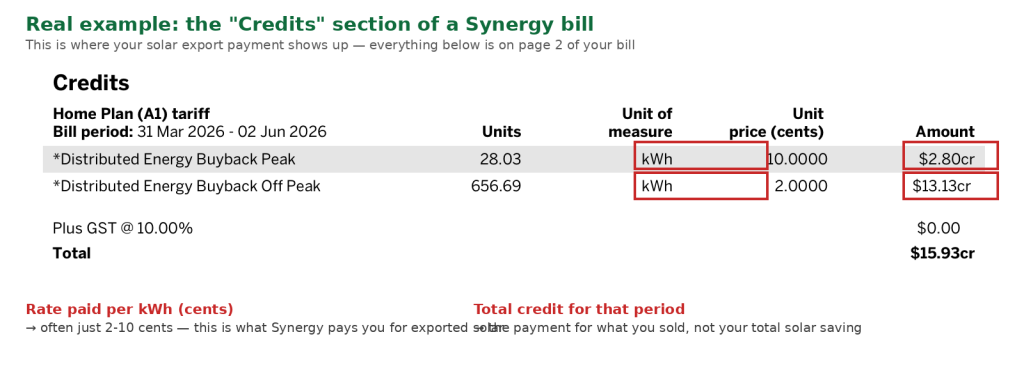
This household exported 28.03 kWh at the peak rate (10c/kWh) and 656.69 kWh at the off-peak rate (2c/kWh). That’s the pattern a battery is built to fix.
What a “credit” actually means
A credit is not a general “solar savings” figure — it’s payment for the extra solar you exported. Your real savings are the times solar ran your house directly instead of you buying from the grid at full price.
Why the rate matters
- ~2c/kWh — off-peak export under DEBS
- ~10c/kWh — peak-period export under DEBS
- ~7c/kWh — flat rate under the older Renewable Energy Buyback Scheme
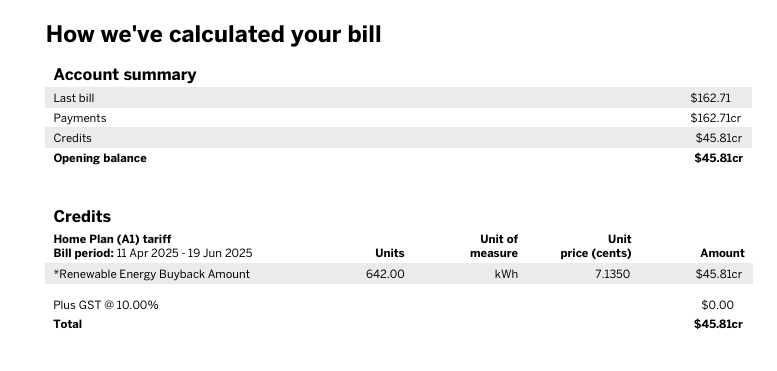
Compare that to buying power back — currently around 31.6c/kWh on a standard Home Plan (A1) tariff.
How much are you actually selling?
Add up all the export lines on your bill — if you’re on DEBS, that means Peak and Off-Peak added together, not just one of them. That total, for your whole billing period, is how much solar energy you’re currently giving away instead of using yourself.
Estimating your battery size
Divide your total exported kWh by the days in your billing period. That gives you your average daily export — roughly how much extra solar your panels produce beyond what your home uses, on a typical day. Take the real DEBS example above: 684.72 kWh exported over that 63-day billing period (31 Mar–2 Jun) works out to about 10.9 kWh/day — pointing to a battery in the 10–15kWh range as a sensible starting size, fine-tuned on site against your actual evening usage pattern (Step 3). This is an estimate to start the conversation, not a final number.
2 Do You Actually Need a Battery?
It depends on your usage pattern, not just on whether you have solar.
You’re a strong candidate if:
You’re exporting a decent chunk of solar during the day, but use a lot of electricity in the evening. A battery captures your own energy instead of selling cheap and buying back expensive.
You need more solar + a battery if:
Your usage is high, but your current solar system isn’t producing enough excess to fill a battery in the first place.
You might not need one yet if:
Your usage is low and mostly daytime, or your system is already well-matched. We’ll tell you if that’s true.
With a battery vs without, at a glance
| Scenario | Without a battery | With a battery |
|---|---|---|
| Midday solar surplus | Exported at 2–10c/kWh | Stored, then self-consumed or exported later at the 10c peak rate |
| Evening electricity | Bought back at ~31.6c/kWh | Drawn from your own stored solar first |
| Blackout | No power, even with solar | Backup possible, if wired for it (Step 3) |
| Rebate eligibility | Not applicable | WA + federal rebates available (WA requires VPP enrolment; federal only requires VPP-capability) |
A general pattern, not a promise — your own numbers depend on your usage, export volume and tariff, which is exactly what Step 1 is for.
Quick WA Battery Rebate Estimator
Move the slider to your rough usable battery size and pick your network — see roughly what the WA state rebate alone is worth. This is an estimate only; your exact figure is confirmed in your formal quote.
3 The Site Visit — What We’re Checking
Where the battery can legally go
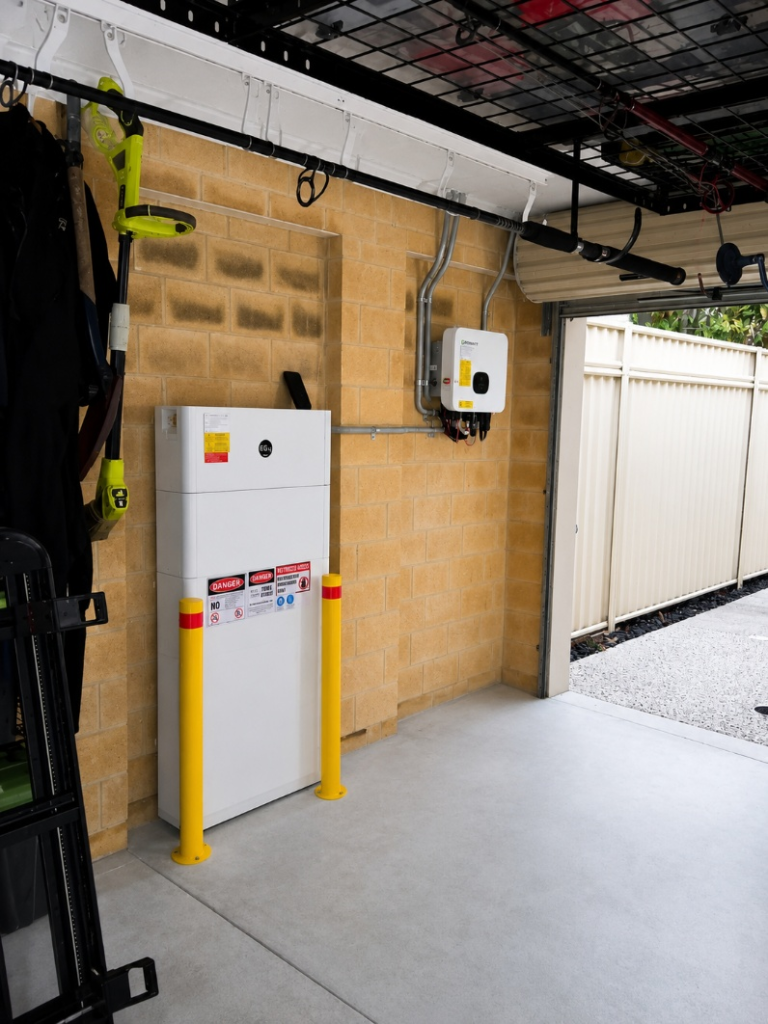
Batteries are an ignition source under the installation standard. We check clearance from windows, vents, doors, gas meters and other appliances.
Your meter box and switchboard
We check location, age, phase (single/three), and room for extra circuits.
The CT meter, if required
Larger/three-phase systems typically need one for accurate import/export measurement — confirmed on site.
Distance for blackout backup
Backup wiring runs to your switchboard — a long distance can mean trenching, costed up front, not sprung on you later.
4 Choosing the Right Battery Size
Sizing starts from your actual export data (Step 1), not a generic rule of thumb — but these bands cover most Perth homes:
10kWh — smaller households, moderate evening usage; the most common Perth size, and comfortably within both rebate thresholds.
15kWh — average family homes, higher evening usage, or households wanting more overnight backup headroom.
20–30kWh — large households, high consumption, or homes planning for EV charging.
Every size band is available across the panels, inverters and batteries we install — the right one comes down to your export numbers and evening usage pattern, confirmed at the site visit (Step 3).
5 Lifespan, Cycles & Adding Storage Later
How lifespan works
Batteries degrade gradually, measured in cycles. Modern LFP batteries are rated for several thousand, backed by a ~10-year product warranty plus a capacity guarantee.
Stackable batteries, non-repeatable rebates
Modules can be added later — but both the WA and federal rebates are one-per-property. Once claimed, expansion doesn’t earn a fresh rebate.
6 Compliance — What the Law Requires
Installers must be SAA-accredited with battery-specific accreditation — non-negotiable, and checked before any rebate pays out.
Inverters must meet AS/NZS 4777.2:2020 (Region B) and, for Synergy customers, the CSIP-AUS protocol.
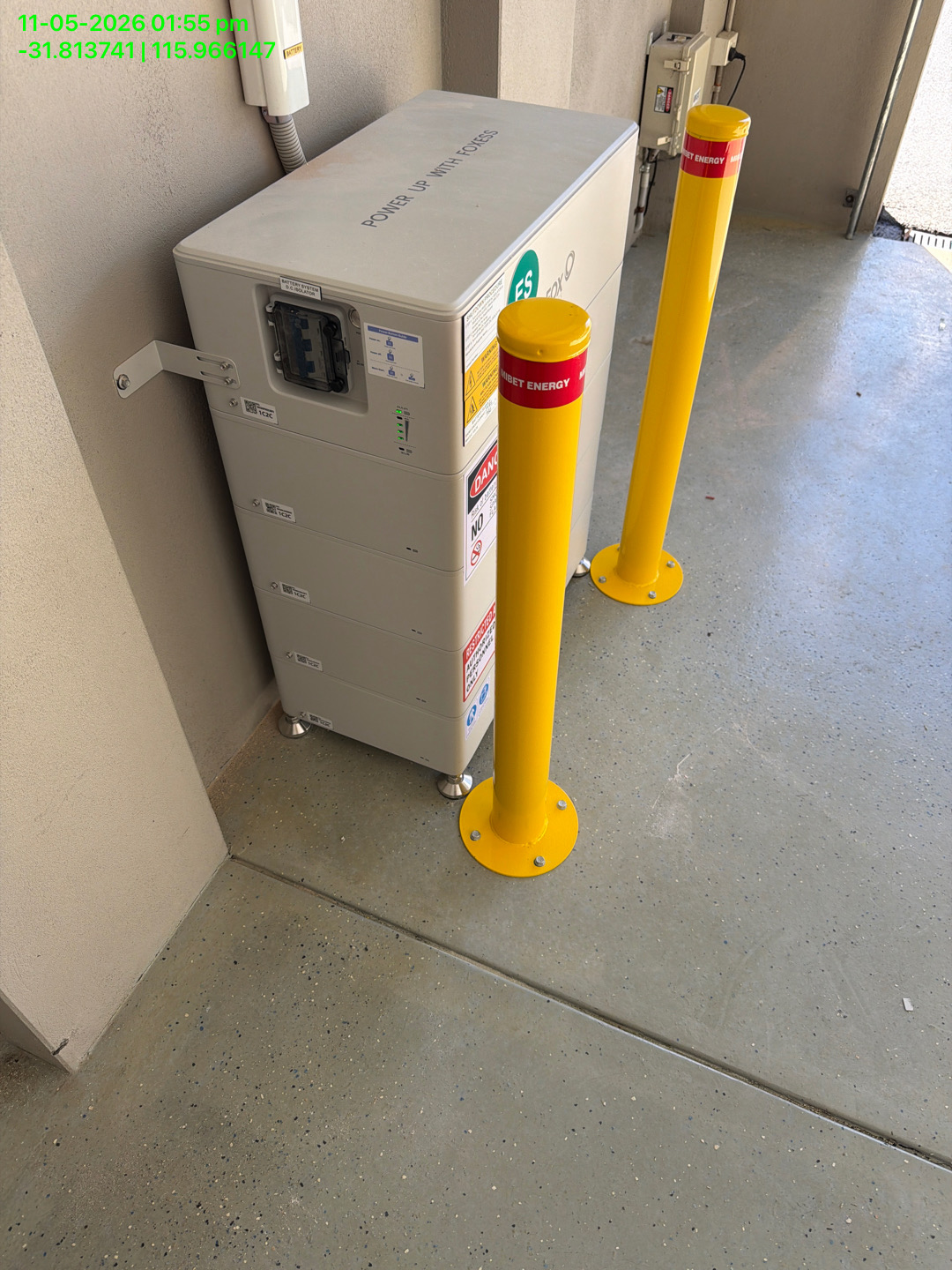
Placement must meet AS/NZS 5139 clearance rules.
7 What Is a VPP, and Why Does It Need Internet?
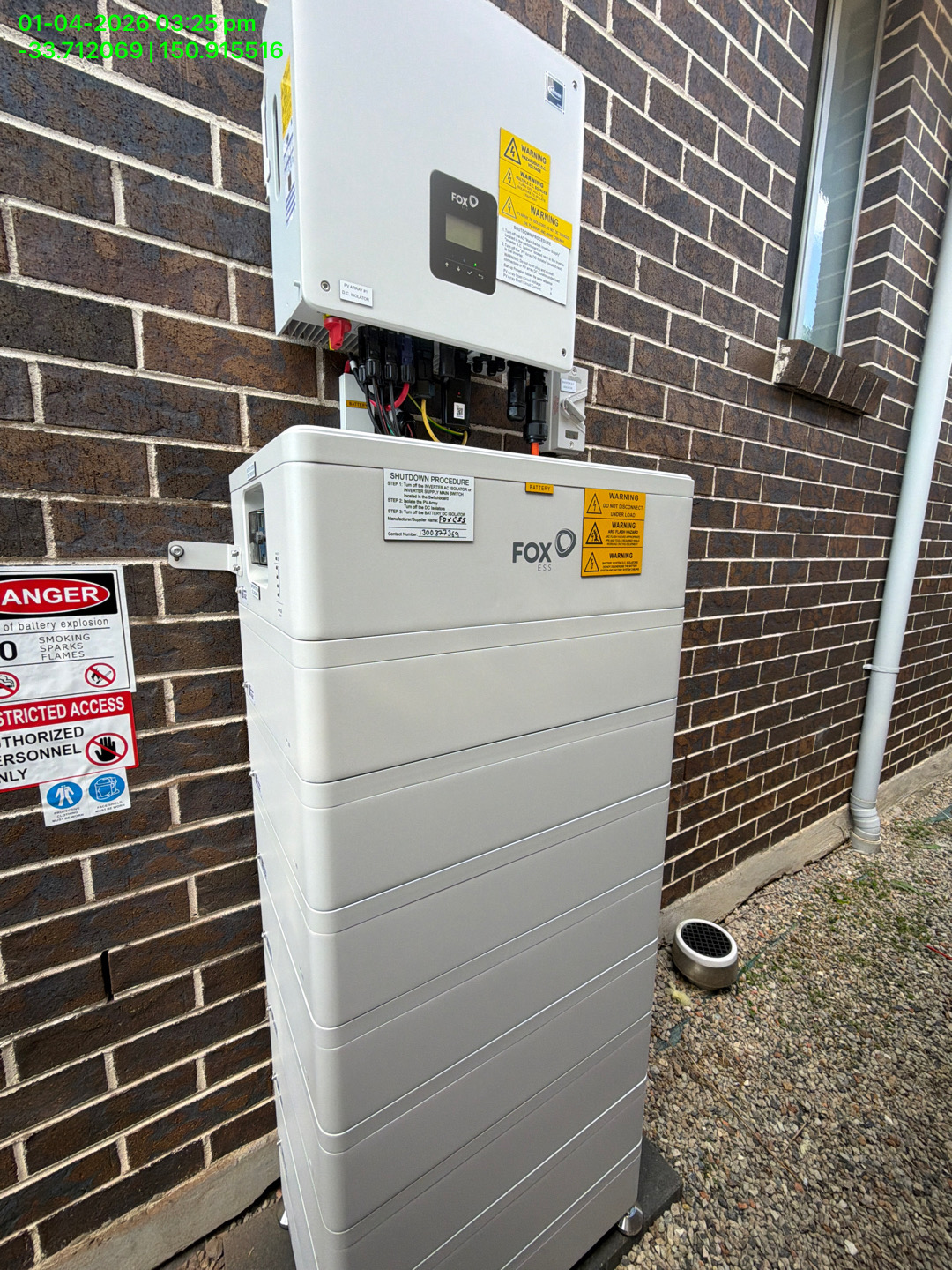
A Virtual Power Plant coordinates many home batteries to support the grid. WA’s approved VPPs: Synergy’s Supported Solution, Horizon Power’s Community Wave, and Plico’s VPP.
VPP enrolment is a core requirement of the WA Residential Battery Scheme — every eligible battery must be VPP-capable and enrolled. A household internet connection is an explicit eligibility requirement.
8 What Rebates Currently Apply
- WA Residential Battery Scheme — see the official WA Government page.
- Federal Cheaper Home Batteries Program — see energy.gov.au.
Horizon Power: $380/usable kWh, capped at $3,800 (at 10kWh)
Federal STC rebate — stepping down
Small-scale Technology Certificates are the same mechanism that’s discounted rooftop solar in Australia for over a decade — batteries were added from 1 July 2025, delivering roughly a 30% discount on an eligible system, applied upfront by your retailer rather than claimed after the fact. Since 1 May 2026, the rebate is tiered by battery size for the first time: 100% of the rate for the first 14 kWh of usable capacity, 60% for the next 14 kWh (14–28kWh), and around 15% for capacity beyond that. The factor is scheduled to keep reducing roughly every six months through to the scheme’s scheduled end at the end of 2030. There is no version of this scheme where waiting gets you a better rate — every scheduled step so far has reduced the incentive, not increased it.
As a rough guide, that’s landed somewhere in the $2,500–$3,700 range recently for a typical 10kWh battery — the exact figure moves with the STC spot price on the day of your install, so treat any number here as a ballpark and ask for the real figure broken out on your quote. Unlike the WA loan below, the federal discount has no income test and no cap on the total number of rebates available — the WA scheme, by contrast, is limited to a planned 100,000 rebates statewide. Full detail: energy.gov.au and the official program page.
How the WA state rebate is actually claimed
This isn’t something you apply for yourself after buying a battery — it’s built into the process we run for you as your accredited vendor:
- Confirm eligibility — Synergy/Horizon Power customer, property in WA, battery size 5–100 kWh, household internet connection, owner-occupier (renter/landlord agreements can still qualify).
- We prepare your quote as an accredited vendor listed on the Plenti Vendor Directory, with SAA-accredited installers.
- We help you choose an approved battery — on your network’s Supported Solutions List (or the CEC-approved list) and VPP-capable.
- We confirm your VPP enrolment as part of your application.
- We submit the application — rebate and, if wanted, the interest-free loan — through the Plenti portal.
- You verify and confirm via a secure email to review the application and formally join the scheme.
- Conditional approval is issued — you then have up to six months to complete installation.
- We arrange network connection approval from Western Power before installation.
- Installation and testing — completed with Western Power and Synergy.
- Funds are released — Plenti pays us directly, reducing your final cost, and draws down any loan.
WA Consumer Protection has specifically flagged high-pressure sales tactics around this scheme elsewhere in the industry — which is exactly why we give you an itemised quote showing the rebate separately, never rush you into signing, and are genuinely listed on the Plenti Vendor Directory.
9 How You Can Pay
Cash / upfront — own it outright from day one.
The Plenti interest-free loan, properly explained
Who’s Plenti? An Australian fintech lender holding a full Australian Credit Licence, formally appointed by the WA Government as administrator and financier for the Battery Scheme’s loan component — not a private buy-now-pay-later provider.
What they offer: a genuinely interest-free loan — 0% interest for the entire term. Loan amounts run from $2,001 to $10,000, with a repayment term of 3 to 10 years, and no early repayment fees.
What it covers: the battery, related equipment like the inverter, and new or upgraded solar panels if installed together with the battery.
What you need to qualify:
- Combined household gross annual income under $210,000.
- A standard credit check against Plenti’s prudential requirements.
- Combined rebate + loan can’t exceed the total purchase and installation cost.
- If a payment is missed, only a capped late fee applies — no hidden penalty interest.
How you apply: we start the process as part of your quote — once you indicate you want the loan, Plenti contacts you directly to finalise the credit check and paperwork.
Standard finance options are also available if the Plenti loan doesn’t suit your situation (for example, over the income threshold).
Common Mistakes We See
- Sizing from a sales brochure, not your bill. A battery sized to “what’s on special” instead of your actual export data (Step 1) either sits half-empty most nights or leaves savings on the table.
- Skipping the VPP fine print. The WA rebate requires ongoing VPP enrolment — find out what that actually commits you to before you sign. (The federal discount is more relaxed: it only requires your battery to be VPP-capable, not actively enrolled.)
- Assuming any electrician can install it. Battery installation needs SAA accreditation specifically, on top of a standard electrical licence — ask to see it.
- Not checking the switchboard first. An older switchboard can need upgrade work that isn’t covered by either rebate — it should show as its own line on your quote, not a surprise afterwards.
- Signing before the rebate is itemised separately. WA Consumer Protection has flagged high-pressure sales tactics in this exact market — a legitimate quote itemises the rebate, it doesn’t fold it into a vague “special price.”
- Ignoring your actual tariff plan. Home Plan A1 and Smart Home Plan have very different peak-import rates, which changes the payback math — confirm which one you’re on before comparing quotes.
Why Solar Red
Approved retailer, locally based, SAA-accredited installers. Brands with real WA support: Growatt, GoodWe, Fox ESS, Alpha ESS, Jinko Solar, all part of our premium solar power products.
Recent Installations
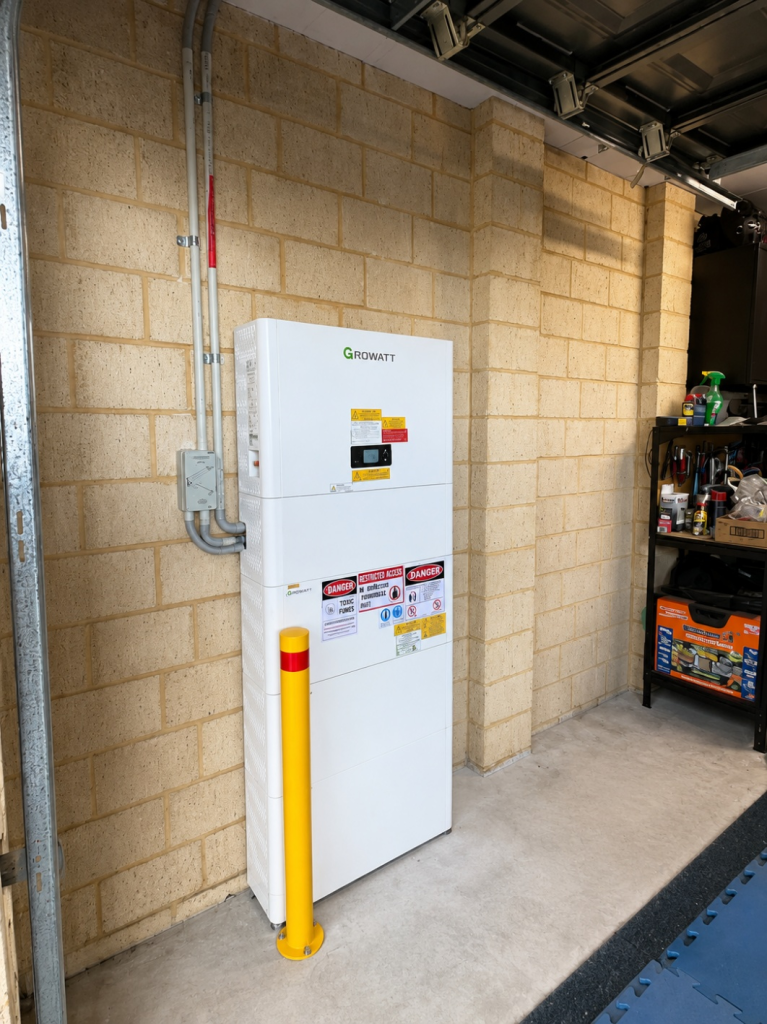
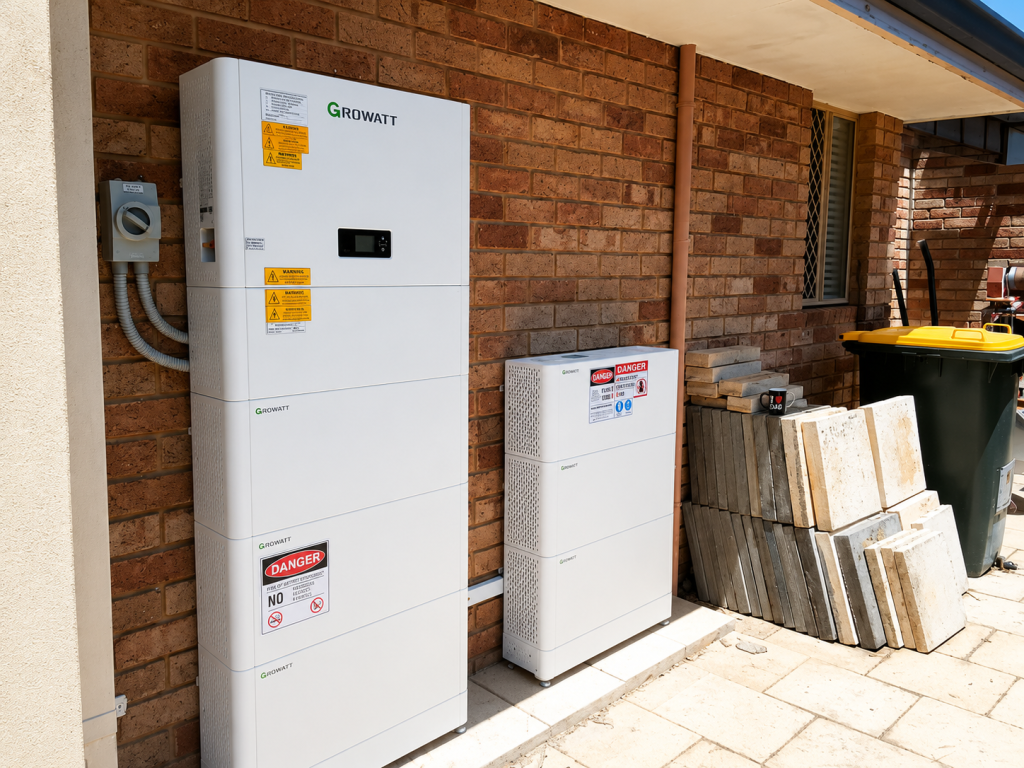
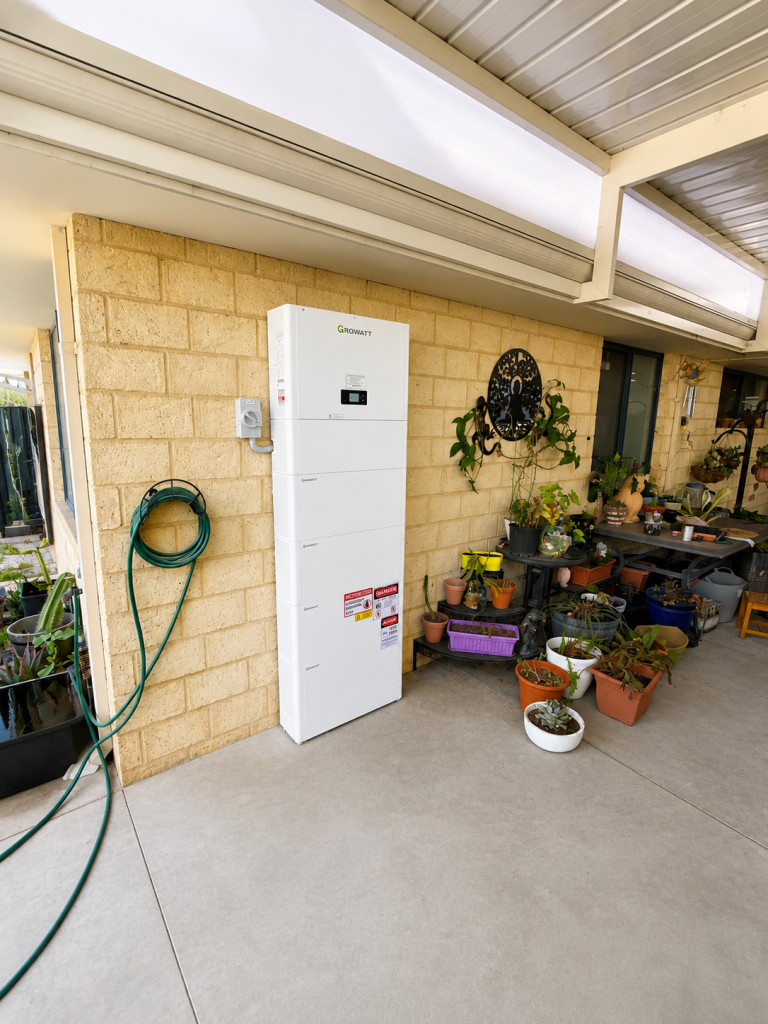
A few real Growatt systems installed on Perth homes — showcasing our residential solar installations across different walls and locations, with the same clearance and compliance standards behind every one.
Ready to find out what your home actually needs?
Send a recent Synergy or Horizon Power bill and we’ll tell you — honestly — whether you’re a battery candidate, a solar-plus-battery candidate, or not quite ready yet.
Get in touch with Solar Red todayOr call 1800 449 733
FAQs
- Is a solar battery actually worth it in Perth?
- For most households exporting solar during the day and using plenty of power in the evening — yes, that gap is exactly what a battery closes (see Key Takeaways above). It’s less clear-cut if your usage is already low and daytime-heavy, or your system barely produces a surplus to store. Step 2 walks through both patterns so you can tell which one you’re in before spending anything.
- Do I need existing solar to get a battery in WA?
- In most cases, yes — the WA rebate requires the battery to be paired with a solar PV system.
- Will a battery work during a Perth blackout?
- Only if configured for backup with a backup gateway and essential circuits wired accordingly.
- How long does installation take in Perth?
- Depends on system size and any switchboard/compliance work found during your site visit.
- Can any electrician install a battery in WA?
- No — it must be an SAA-accredited installer with battery-specific accreditation.
- Do I have to stay in a VPP forever to keep the rebate?
- Enrolment is a condition of the rebate, so ongoing participation is part of the deal.
- What if I don’t have reliable home internet?
- Flag it early — internet is a rebate eligibility requirement, so options are discussed at the site visit.
- Is Plenti a normal finance company I should be wary of?
- No — it’s the WA Government’s officially appointed administrator and financier for this scheme.
- What’s the difference between Synergy and Horizon Power battery rebates?
- Synergy customers get $130/kWh capped at $1,300; Horizon Power (regional WA) customers get a higher $380/kWh capped at $3,800.
- Does the federal battery rebate have an income test?
- No — unlike the WA no-interest loan, the federal STC-based discount isn’t means-tested and has no cap on the total number available.
- What if my switchboard isn’t ready for a battery?
- It’s checked at the site visit (Step 3). Any upgrade work isn’t covered by either rebate, so it should appear as its own line on your quote.
- Roughly what does a battery cost after both rebates?
- It varies by size and brand — ask for an itemised quote showing the gross price, federal discount and WA rebate as three separate lines, not folded into one bundled “special price.”
Battery Safety & Placement
How long will it actually last?
Most quality LFP batteries carry a ~10-year manufacturer warranty plus a capacity guarantee.
Age or usage — which matters more?
Usage. Life is measured in cycles, not purely years.
Will it catch fire?
Modern batteries use LFP chemistry, chosen for home storage because it’s significantly more thermally stable than older lithium chemistries. Genuine incidents are rare and overwhelmingly linked to poor-quality products or incorrect installation.
Can it go outside unshaded?
Batteries have a specified operating temperature range — unshaded western/northern sun through a WA summer can accelerate degradation. Confirmed against the manufacturer’s manual during your site visit.
Glossary
- DEBS (Distributed Energy Buyback Scheme)
- Synergy’s current export payment structure, paying different rates for peak (3pm–9pm) and off-peak exported solar.
- VPP (Virtual Power Plant)
- A network of home batteries coordinated together to support grid stability. The WA rebate requires ongoing enrolment; the federal discount only requires your battery to be VPP-capable.
- STC (Small-scale Technology Certificate)
- The certificate mechanism behind the federal battery and solar discount — your retailer typically claims these on your behalf and passes the value on as a lower upfront price.
- Usable capacity
- The portion of a battery’s total capacity that can actually be charged and discharged day-to-day, usually slightly less than its nameplate size — the figure rebates are calculated against.
- CT meter
- A current transformer meter that measures the exact flow of electricity in and out of your system, often required for larger or three-phase installations.
- LFP (Lithium Iron Phosphate)
- The battery chemistry used in most modern home batteries, chosen largely because it’s more thermally stable than older lithium chemistries.
- CSIP-AUS
- The communication protocol Synergy requires compliant inverters to support for grid coordination in WA.