
In this guide
Western Australia has one of the highest rates of rooftop solar in the country, but most of that power is generated during the day while electricity demand — and cost — peaks in the evening. A home battery closes that gap, and two government incentives currently make one considerably cheaper to install: the WA Residential Battery Scheme and the federal Cheaper Home Batteries Program (CHBP). They stack.
Here’s exactly how each one works, what changed on 1 May 2026, and what to check before you sign a contract.
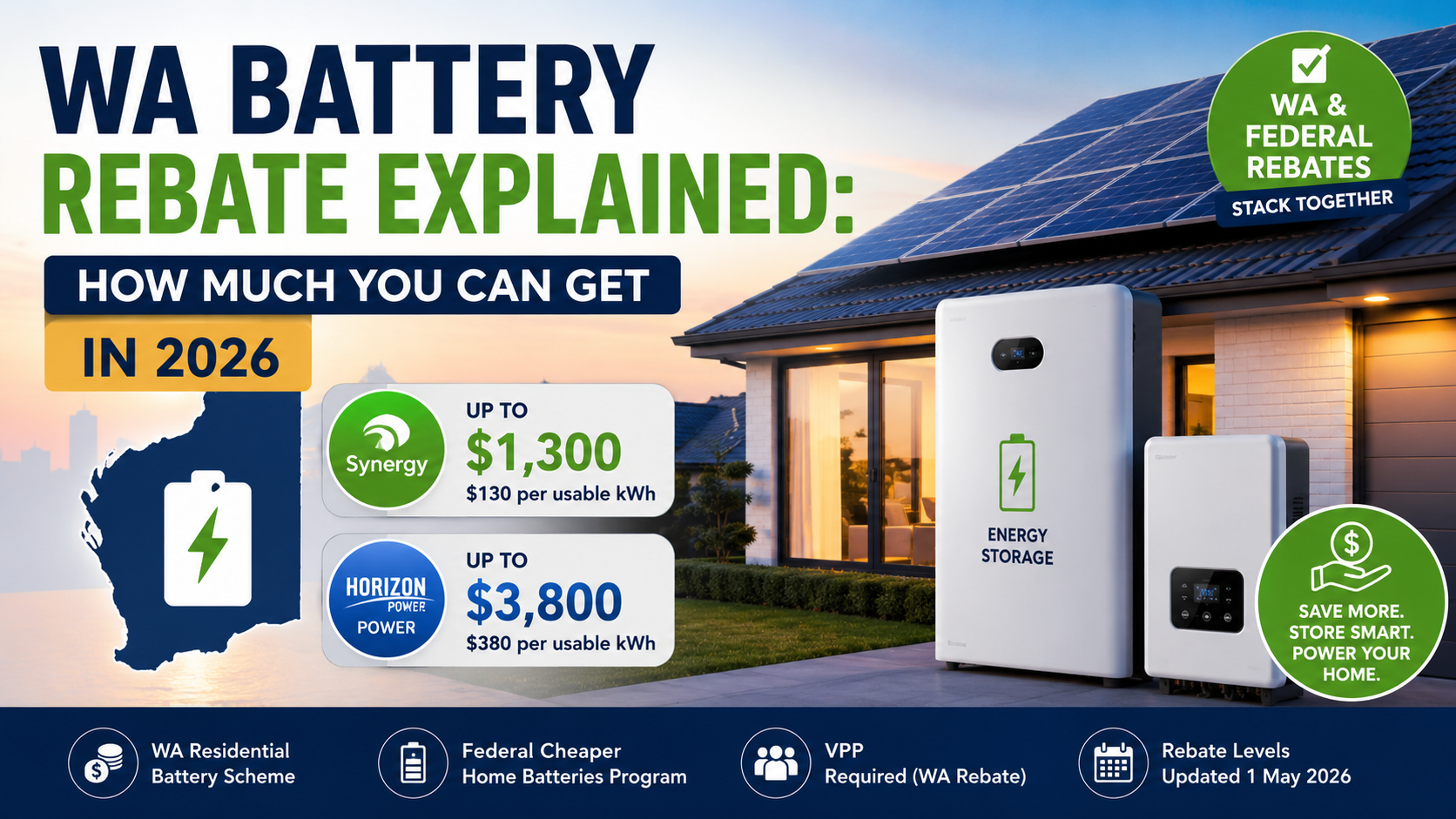
How Much Is the WA Battery Rebate?
The WA Residential Battery Scheme pays a rebate based on your electricity network:
| Network | Rebate | Cap |
|---|---|---|
| Synergy (Perth metro, Mandurah, Bunbury, Albany, Geraldton — SWIS network) | $130 per usable kWh | $1,300 (at 10 kWh) |
| Horizon Power (regional and remote WA) | $380 per usable kWh | $3,800 (at 10 kWh) |
If your battery is larger than 10 kWh, you still only receive the capped amount — the rebate applies to the first 10 kWh of usable capacity only, and it’s one rebate per property.
Conditions for the WA rebate
- Minimum 5 kWh usable capacity.
- Battery and inverter must appear on your network’s Supported Solutions List (Synergy’s or Horizon Power’s).
- Installed by an SAA-accredited vendor — you can’t just use any electrician.
- Must be enrolled in an approved Virtual Power Plant (VPP). For Synergy customers that’s typically Synergy Battery Rewards or Plico’s VPP; for Horizon Power customers it’s Community Wave. Other VPPs may qualify if they meet the scheme’s value-sharing rules. You’re not locked in forever — battery owners can opt out of the VPP agreement after two years.
- The scheme covers 100,000 rebates in total, released in rounds — it isn’t unlimited.
The Interest-Free Loan
Separate from the rebate, households with a combined income under $210,000 can also access a zero-interest loan of $2,000–$10,000, repayable over up to 10 years, administered by Plenti. It can be put toward the battery and toward solar panels if they’re installed at the same time. This is genuinely useful if you’d rather spread the remaining cost than pay it upfront — worth asking your installer whether they’re an approved vendor for it.
The Federal Battery Rebate (Cheaper Home Batteries Program)
On top of the WA rebate, eligible batteries also get a discount through the Australian Government’s Cheaper Home Batteries Program, which started 1 July 2025 and runs to 2030. It’s delivered through Small-scale Technology Certificates (STCs) — the same mechanism that’s discounted rooftop solar for over a decade.
- No application needed — the discount is applied by your installer as a line item on the quote.
- No income test.
- Covers systems from 5–100 kWh nominal capacity (STCs apply to the first 50 kWh usable).
- It’s not compulsory to join a VPP to get the federal rebate (unlike the WA rebate), but the battery must be VPP-capable.
What changed on 1 May 2026
This is the part most older blog posts still get wrong, because the change has already happened as of today, not something still “coming.” From 1 May 2026, the rebate moved from a flat rate to a tiered structure based on battery size:
| Usable Capacity | Share of Full Rebate |
|---|---|
| 0–14 kWh | 100% |
| 14–28 kWh (next 14 kWh) | 60% |
| 28–50 kWh (remaining capacity) | 15% |
The rebate then keeps stepping down roughly twice a year — around the start and middle of each year — all the way through to the scheme’s scheduled end in 2030. Installing earlier locks in the rate for that date; the factor is set by installation date, not quote date.
What Else Changed in WA on 1 May 2026
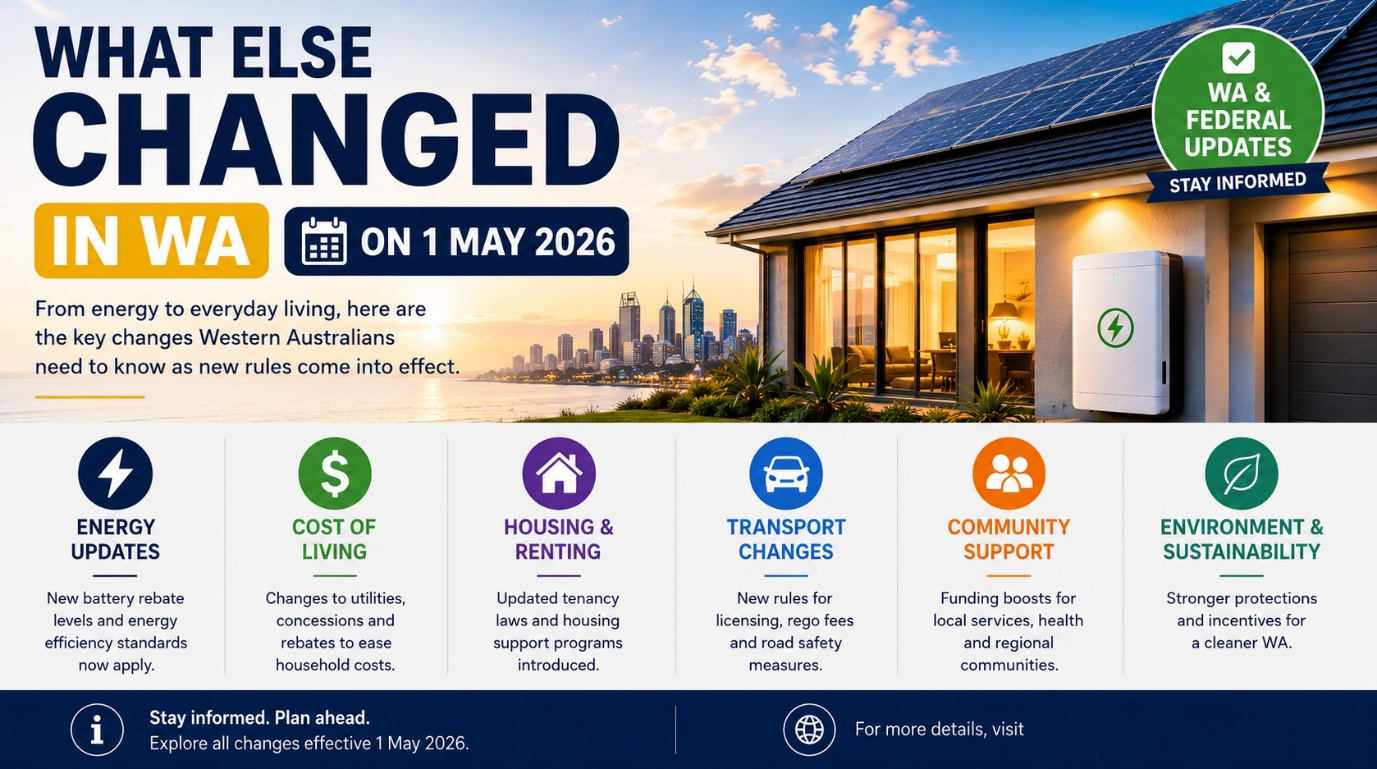
Separately from either rebate, Western Power updated the technical connection requirements for new and upgraded solar/battery systems on the SWIS network from the same date:
- Systems up to 30 kVA are now eligible for the standard connection process (covers almost all residential installs).
- Inverters must comply with AS/NZS 4777.2:2020, set to “Australia Region B.”
- Synergy customers now need the CSIP-AUS communications protocol.
- Systems installed before 1 May 2026 don’t need to be retrofitted.
- Systems that don’t meet the new standard will have their exports limited to 1.5kW until they comply — worth checking with your installer if this affects an existing application.
This is a compliance detail rather than a dollar figure, but it’s easy for a homeowner to get caught out by if their installer isn’t across it — worth confirming directly with whoever quotes you. If Western Power has queried your application over connection points or documentation, see our battery installation Perth page.
Rebates Are a One-Off Benefit, Not a Recurring Payment
Worth stating plainly, because it’s a common misunderstanding: neither rebate is paid every year. Both are one-off, upfront incentives applied at the time of installation.
- You don’t get another WA rebate the following year.
- The same battery can’t claim the rebate twice.
- A future battery replacement is assessed as a new system under whatever rules apply at that time.
The ongoing financial benefit after installation comes from using more of your own solar instead of buying it back from the grid at peak rates — not from further rebate payments.
Why Both Federal and State Support Reduce Over Time
Both solar panel STCs and battery STCs run on the same underlying mechanism, and both decline over time — that’s by design, not a glitch:
- Solar STCs decline through a shrinking “deeming period.” A system installed today generates fewer certificates than the same system would have a few years ago, and that number gets smaller each year until the scheme winds down at the end of 2030.
- Battery STCs now decline on a faster schedule — roughly every six months from 1 May 2026 onward, rather than the old annual adjustment — on top of the new size-based tiering described above.
Choosing the Right Battery Size for Your Perth Home
The right size depends on your electricity usage, existing solar system, evening consumption, backup needs, and future plans like EV charging.
| Size | Suited to | Federal tier impact |
|---|---|---|
| 10kWh Battery Perth | Smaller households, moderate evening usage | Sits entirely inside the top 100% tier |
| 15kWh Battery Perth | Average family homes, higher evening usage | Part falls into the 60% tier |
| 20–30kWh Battery Perth | Large homes, high consumption, EV charging | Meaningful share above 28 kWh sits in the reduced 15% tier |
Bigger isn’t automatically better value once you factor in the tiering — it’s worth having someone model your actual usage rather than just buying the biggest battery on the price list. → Talk to us about sizing
Adding a Battery to Existing Solar Panels
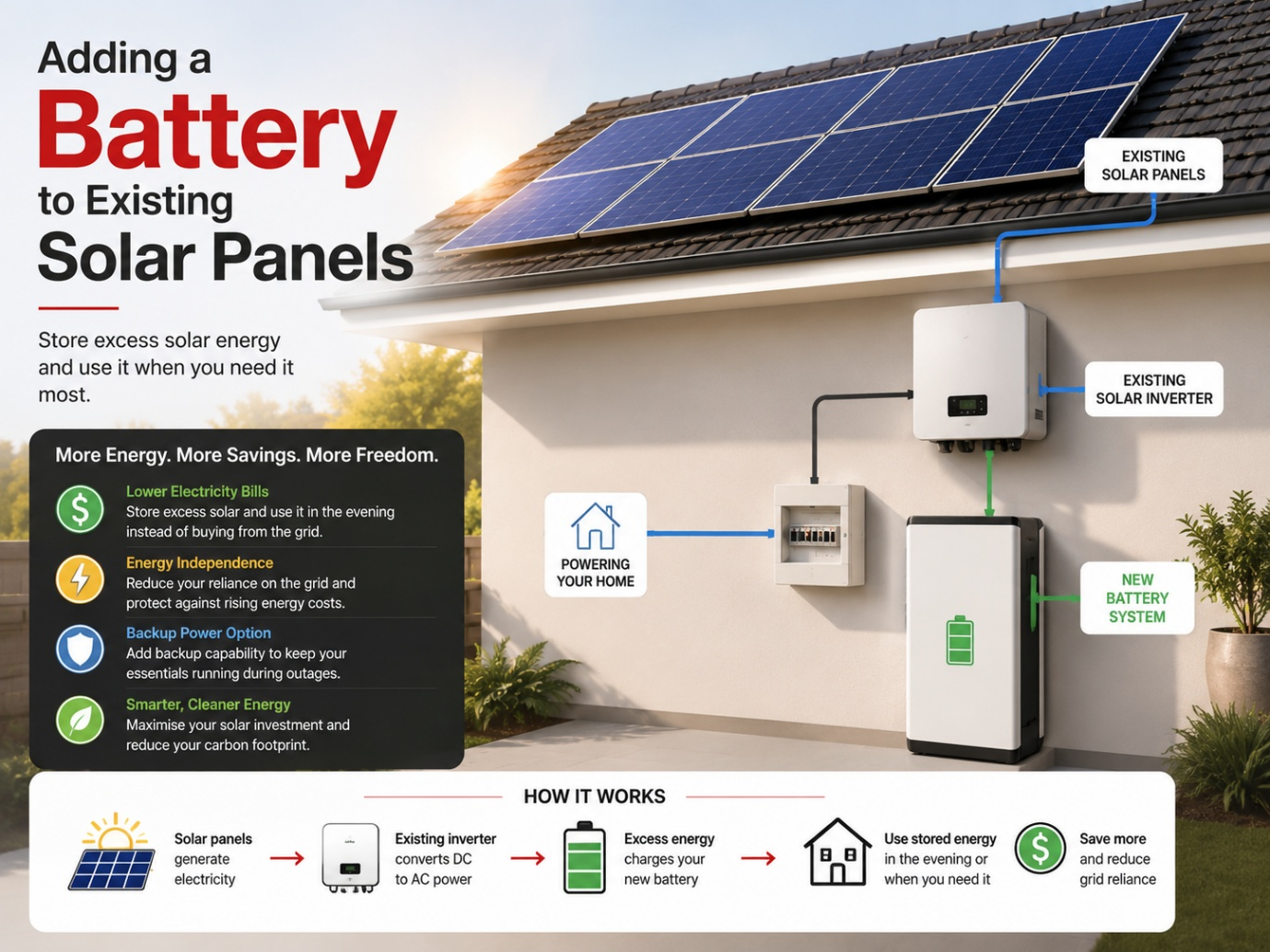
Many Perth homes already have solar installed. Before adding a battery, an installer should check:
- Existing inverter compatibility
- Solar panel condition
- Switchboard capacity
- Single-phase vs three-phase supply
- Western Power connection requirements (see the 1 May 2026 standards above)
- Any export limitations on your network agreement
AC-coupled systems suit existing solar setups where you don’t want to replace the current inverter. → Solar Battery Perth
Hybrid systems suit new installs or a full upgrade of an older system. → Solar Panels Perth
Does a Battery Work During a Blackout?
Not automatically.
A standard grid-connected battery won’t keep your home running in a blackout unless it’s specifically configured for backup — which usually needs a backup gateway, a compatible inverter, and essential loads wired on a separate circuit. Most households prioritise the fridge, lighting, internet, and security; big loads like air-conditioning or pool equipment need extra planning. → Residential Battery Backup
Not sure what your network and battery size qualifies for?
We’ll work it out against your actual usage — not just sell you the biggest battery on the price list.
Get a battery quoteWhy Choose Solar Red for Battery Installation Perth?
Solar Red helps Perth homeowners:
- Work out exactly what their network and battery size qualifies for
- Choose the right battery size for actual usage, not just the biggest option
- Compare battery options on real value — warranty, cycle life, backup capability, not just price
- Check compatibility with an existing solar system
- Handle compliant installation and current Western Power connection requirements
- Maximise self-consumption and long-term solar savings
Frequently Asked Questions
- How much is the WA Battery Rebate?
- $130 per usable kWh for Synergy customers (capped at $1,300), or $380 per usable kWh for Horizon Power customers (capped at $3,800). Both cap out at 10 kWh of usable capacity.
- Are battery rebates paid every year?
- No. Both the WA and federal rebates are one-off incentives applied at the time of installation, not recurring payments.
- What changed with the federal battery rebate on 1 May 2026?
- The rebate moved from a flat per-kWh rate to a tiered structure: 100% of the rate for the first 14 kWh, 60% for the next 14 kWh, and 15% for capacity between 28–50 kWh. The base rate also dropped as part of the scheduled step-down.
- Do STCs reduce every year?
- Yes, for both solar and battery systems. Solar STCs decline through a shrinking deeming period; battery STCs now step down roughly twice a year through to 2030.
- Do I need to join a VPP?
- For the WA state rebate, yes — it’s mandatory, though you can opt out after two years. For the federal rebate, no, though the battery must be VPP-capable.
- Do I need existing solar panels to get the WA battery rebate?
- Yes, the WA Residential Battery Scheme requires the battery to be paired with a solar PV system.
- Is a battery worth it in Perth in 2026?
- For most homes with solar, yes — it increases self-consumption and cuts reliance on grid electricity at peak rates, and the combined rebates still meaningfully reduce the upfront cost even after the May 2026 changes. The right answer depends on your usage pattern, so it’s worth getting it modelled rather than assuming.
- What happens if my system doesn’t meet the new Western Power connection standard?
- Exports are limited to 1.5kW until the system complies. Systems installed before 1 May 2026 aren’t required to be retrofitted, but new and upgraded systems need to meet the standard from that date.