

In this guide
- What the loan actually is
- Who can apply
- Why there’s no state rebate
- Filling out the application
- How your income is checked
- Downloading your tax return from myGov
- How the credit check works
- Why two lenders, and why Plenti
- Loan term: why 10 years can be smarter
- The optional VPP incentive
- Application process & timeline
- FAQs
- Sources
NSW’s Home Energy Saver program launched on 17 June 2026 — genuinely new, and structured differently from equivalent schemes in other states. No standalone state rebate, a larger loan cap, two lenders instead of one, and no VPP requirement attached. This is the detailed version: who actually qualifies, what Plenti looks at, exactly how to find the documents they’ll ask for, and where NSW’s setup differs from what you might have heard about other states’ schemes.
What the Loan Actually Is
The NSW Home Energy Saver loan is a no-interest financing program launched by the NSW Government on 17 June 2026, backed by $480 million of a broader $557 million package. It replaces and significantly expands the state’s earlier Empowering Homes Program — a bigger loan cap and a higher income threshold than what came before it.
The numbers
- Loan amount: up to $15,000
- Term: up to 10 years, your choice
- Interest: 0%, fixed, for the entire term
- No application, account-keeping, or early repayment fees
What it can cover
- Solar panels
- Home batteries
- A range of other energy-saving upgrades under the program’s rules
- Delivered through an accredited installer, not applied for directly with the government
Who Can Apply
Eligible
Australian citizens or permanent residents who own or rent out a residential property in NSW — both owner-occupiers and landlords are eligible, which is broader than some other states’ schemes. Household combined gross income must be $210,000 or less.
Also required
Standard credit assessment through whichever lender you choose (Brighte or Plenti), and installation through an accredited vendor for the program.
Worth checking directly
Specific eligible upgrade types, and whether a given property type (strata, embedded networks) qualifies — the program’s exact rules are still being finalised in places, so confirm anything unusual with your installer before assuming either way.
Why There’s No State Rebate — And What NSW Has Instead
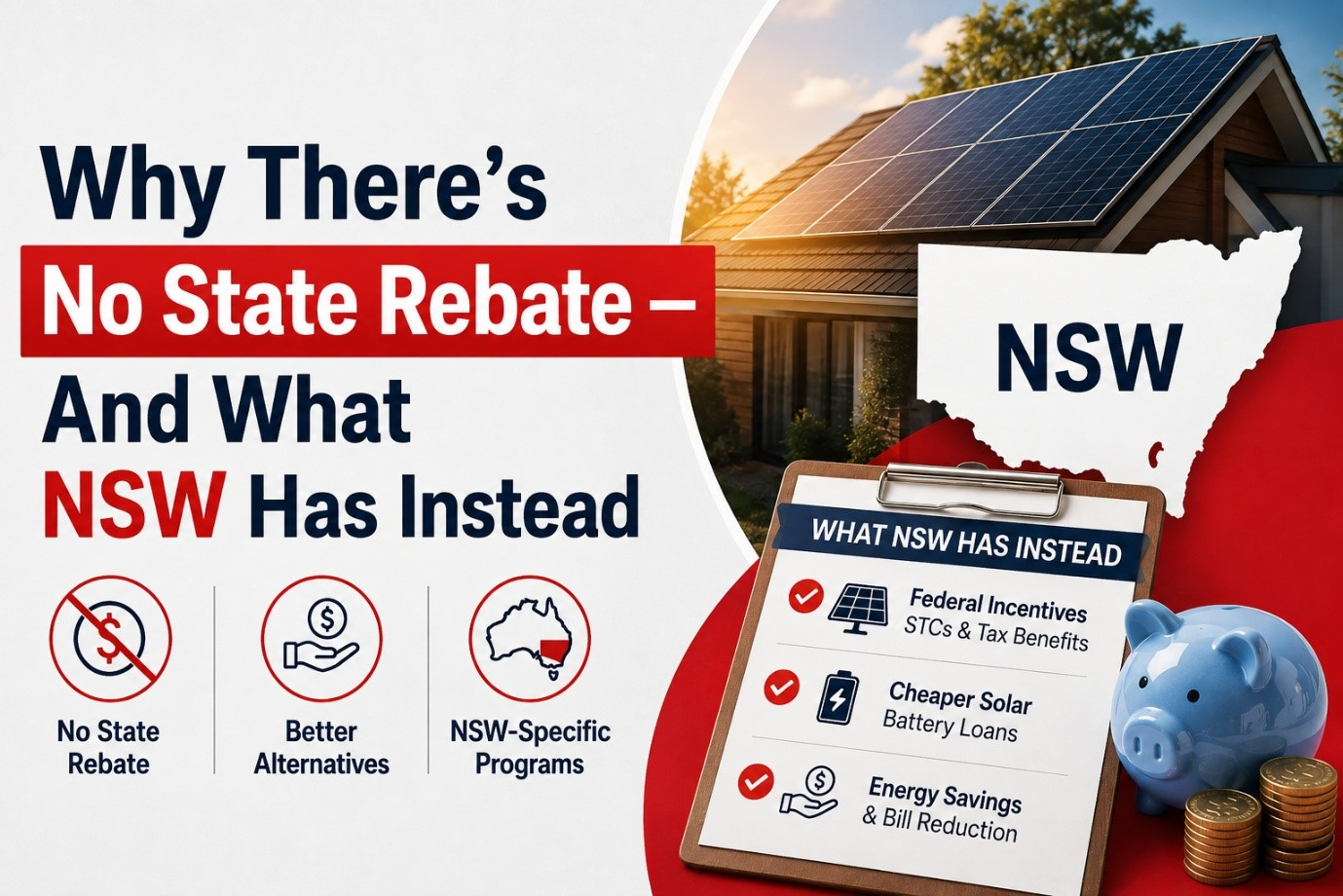
NSW does not have a standalone state battery rebate. That’s not an oversight in this guide — it’s simply how the scheme is structured.
What NSW has instead is a different combination of support:
| Support | What it is | Status |
|---|---|---|
| Federal Cheaper Home Batteries Program | Upfront discount, applies Australia-wide | Live now |
| NSW Home Energy Saver Loan | Up to $15,000, 0% interest, 10 years | Live now |
| NSW Home Energy Saver Discount | Up to $4,000, for households under $80,000/yr or concession card holders | Not yet available |
| NSW VPP Incentive | Roughly $1,000–$1,500, optional, separate scheme | Live now, opt-in |
The separate $4,000 discount is worth knowing about if your household earns under $80,000 a year or holds an eligible concession card, but it isn’t live yet — the NSW Government has only said “later in 2026” without a confirmed date. Don’t delay an otherwise-ready installation waiting on it; ask your installer to flag if it becomes available before you commit.
Filling Out the Application, Step by Step
This is what the actual Plenti application looks like, screen by screen. It takes about 10 minutes, and Plenti aims to give a decision within seconds of submitting. Before you start, have your driver licence on hand and know roughly what your system will cost.
Step 1: Payment Plan Details

Enter your total system cost and any deposit you’re putting down. There’s no state rebate line on this screen — NSW doesn’t have one, so the amount to finance is simply your system cost minus your deposit. Then choose your preferred finance term; your estimated monthly repayment updates automatically once you do.
Step 2: System Details

Your installer’s quote translated into the application — solar panel size in kW, battery size in kWh, and an estimate of your electricity bill savings, with a frequency (weekly, monthly, or quarterly). You’ll also confirm the savings estimate has been explained to you and is based on reasonable assumptions.
Step 3: Your Details

Plenti is explicit about this one: enter your name exactly as it appears on your driver licence. A mismatch is the single biggest cause of identity verification failing instantly instead of being automatic.
You’ll also enter your email and mobile number — Plenti uses these for application updates and, in some cases, two-factor verification during identity checks.
Steps 4–7: Address, Financial Details, Living Expenses & Bank Details

Four shorter steps in sequence:
- Step 4 — Your address: type your residential address and select it from the suggested list rather than typing the full thing manually, to reduce data-entry mismatches.
- Step 5 — Your financial details: a yes/no confirmation that your household earns $210,000 or less. This is a declaration Plenti verifies against your submitted income documents afterward — answer accurately.
- Step 6 — Your living expenses: regular expenses excluding mortgage, rent, loan and card repayments. A “Help me calculate” tool is available if you’re not sure offhand.
- Step 7 — Your bank details: BSB and account number for direct debit repayments.
Step 8: Complete and Submit

Five consent questions before you can submit — read each one, since they cover genuinely different things: agreement to Terms and Conditions; authorisation for Plenti to access your credit report (this is where Plenti explicitly flags this may affect your credit score); consent for identity verification against the document issuer; confirmation you’ve read the Credit Guide and Quote; and consent to receive disclosure documents electronically.
Want help filling this out in person?
We’re an accredited Plenti vendor — we can walk through the application with you at the quote stage.
Book a consultationHow Your Income Is Checked
For the loan application, Plenti asks for documentation covering three things: your identity, your income, and your regular financial commitments.
Identity
- Driver’s licence or passport
Income
- Recent payslips, or
- Individual tax return (ITR), or
- Pension statement, if applicable
- A breakdown of regular expenses and financial commitments
Plenti processes this digitally — payslip and tax return data is extracted and verified automatically as part of their credit engine, which is a large part of why a straightforward application can be assessed quickly. Accurate, complete information the first time is what actually determines speed here.
Downloading Your Individual Tax Return from myGov
Plenti asks for your Individual Tax Return (ITR) — the fuller document showing your actual declared income, not the shorter Notice of Assessment. Here’s exactly how to get it, on both a computer and a phone.
On a Computer
On a Phone
iPhone: saving as PDF
- Tap Share → Print
- Pinch outwards on the print preview to open it as a full PDF
- Tap Share again
- Choose “Save to Files”
Android: saving as PDF
- Tap the three dots (⋮) or the Print icon
- Choose “Save as PDF”
- Tap Download
How the Credit Check Works
Alongside the income documents, your chosen lender runs a standard credit assessment — the same category of check most Australian lenders use for a personal loan. In practice this covers:
- Identity verification — confirming you are who your ID documents say you are
- Credit file check — your credit history through standard credit reporting bureaus
- Ability-to-repay assessment — declared income weighed against declared expenses and commitments
- Fraud and anti-fraud checks — automated checks flagging inconsistencies in submitted documents
A past default or thin credit file doesn’t automatically mean rejection, but it’s assessed as part of the whole picture. Most credit bureaus let you request your own free credit report before applying if you want to check where you stand first.
Why Two Lenders, and Why Plenti
NSW’s Home Energy Saver program is delivered through two accredited finance providers — Brighte and Plenti — rather than the single-lender approach some other states use. Both are established Australian consumer finance companies; which one is available to you generally depends on which lender your chosen installer is accredited with.
Solar Red is an accredited Plenti vendor, which is why this guide walks through Plenti’s specific application screens. Plenti holds an Australian Credit Licence and has delivered comparable government-backed finance programs in other states — an established platform for processing this kind of application at scale, not a first-time rollout.
If you’re comparing installers and one is only accredited with Brighte, that’s not a red flag — it just means your application would go through a different (but functionally similar) lender.
Loan Term: Why 10 Years Can Be the Smarter Choice
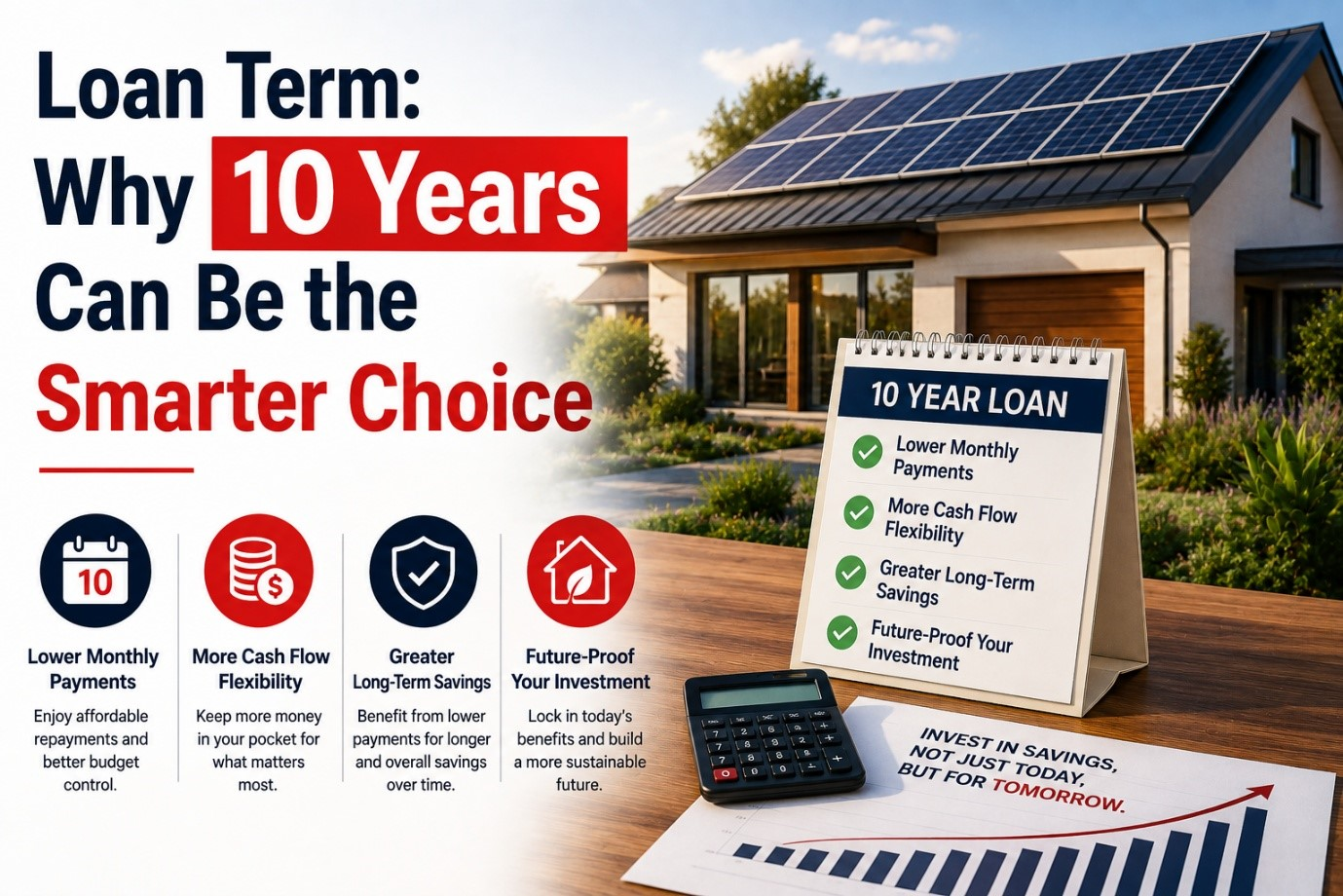
Because the loan is 0% interest for its entire term, the term length works differently here than it does for a normal loan.
A normal interest-bearing loan
The NSW 0% loan
The Optional VPP Incentive
Whether it’s worth doing is a genuinely personal call. Some households value the extra payment and don’t mind their provider occasionally drawing on stored energy to support the grid; others would rather keep full control over their battery’s charge and discharge and skip it. Either way, it’s worth asking your installer whether your specific battery model is VPP-compatible before you decide — not every battery on the market is.
Application Process & Timeline
The application is initiated by your accredited installer, not lodged by you directly with Plenti, Brighte, or the NSW Government.
For everything else about sizing and choosing the system itself, see our battery brand comparison.
Frequently Asked Questions
- Who can apply for the NSW Home Energy Saver loan?
- You need to be an Australian citizen or permanent resident, and either own or rent out a residential property in NSW — both owner-occupiers and landlords are eligible. Your household’s combined gross income needs to be $210,000 or less, and you’ll need to meet the finance provider’s standard credit assessment.
- Does NSW have a standalone state battery rebate?
- No. NSW does not have a standalone state battery rebate. What NSW does have is the Home Energy Saver interest-free loan (up to $15,000), a separate targeted discount of up to $4,000 for lower-income households (not yet available), and an optional Virtual Power Plant incentive worth roughly $1,000 to $1,500 depending on battery size. The federal Cheaper Home Batteries Program discount still applies in NSW, the same as everywhere else in Australia.
- How much can I borrow and over what term?
- Up to $15,000, at 0% interest, repaid over a term of your choosing up to 10 years. There are no application fees, account-keeping fees, or early repayment fees.
- Do I have to use Plenti, or can I choose a different lender?
- The NSW Home Energy Saver loan is delivered through two accredited finance providers: Brighte and Plenti. You can choose either, though your installer needs to be accredited with whichever provider you pick. Solar Red is an accredited Plenti vendor, so this guide walks through the Plenti application specifically.
- How do I download my Individual Tax Return from myGov?
- Sign in to myGov, select the Australian Taxation Office, click Tax, then navigate to Lodgement, Income Tax, then History. Select the relevant financial year and view details, then open the print-friendly version and save it as a PDF — on a computer using your browser’s print-to-PDF option, or on a phone using the Share/Print menu.
- Do I need to join a Virtual Power Plant to get this loan?
- No. Joining a Virtual Power Plant is not a requirement for the NSW Home Energy Saver loan or the federal battery rebate. It’s a separate, optional incentive worth roughly $1,000 to $1,500 depending on your battery’s usable capacity, available if you choose to connect your battery to a participating VPP provider.