
In this guide
A 20kWh solar battery sits in the gap most Perth homes actually live in — bigger than the 10–13.5kWh systems that suit a typical household, but without stepping up to the heavier-duty 28kWh-plus class built for pool pumps, ducted air conditioning and EV charging all at once. It’s often the size that matches a genuinely large family home without paying for capacity that never gets used.
What 20kWh Actually Gives You
In practical terms, a 20kWh battery can typically carry a household through a full evening peak-price window and overnight, with enough left over to handle an unusually heavy evening — visitors, a big cook-up, or a hot night with air conditioning running longer than usual. It’s not built around simultaneous heavy loads like a pool pump and ducted air con running together for hours, which is where the 28kWh class earns its keep instead.
Who Actually Needs This Size
Good fit
4–6 person households with strong but not extreme evening usage — cooking, lighting, standard air conditioning, entertainment, and everyday appliances, generally landing in the 15–20kWh/day range.
Worth modelling first
Households sitting closer to 12–15kWh/day usage but expecting it to grow — a new baby, a family member moving in, or a first EV on the way within a year or two.
Consider a different size
Under 12kWh/day usage — a 10–13.5kWh battery will likely return better value. Over 25kWh/day, or running a pool pump and ducted air conditioning together — see our 28kWh guide instead.
Battery ROI Calculator
Full breakdown of where your electricity actually comes from each day — direct solar use, battery-stored solar, grid draw, and export — not just a single savings figure.
Is a Battery Worth It?
Enter your numbers and see your estimated daily and annual savings, plus payback time — with a full breakdown of where every kWh actually goes.
How the Rebate Splits Across a 20kWh Battery
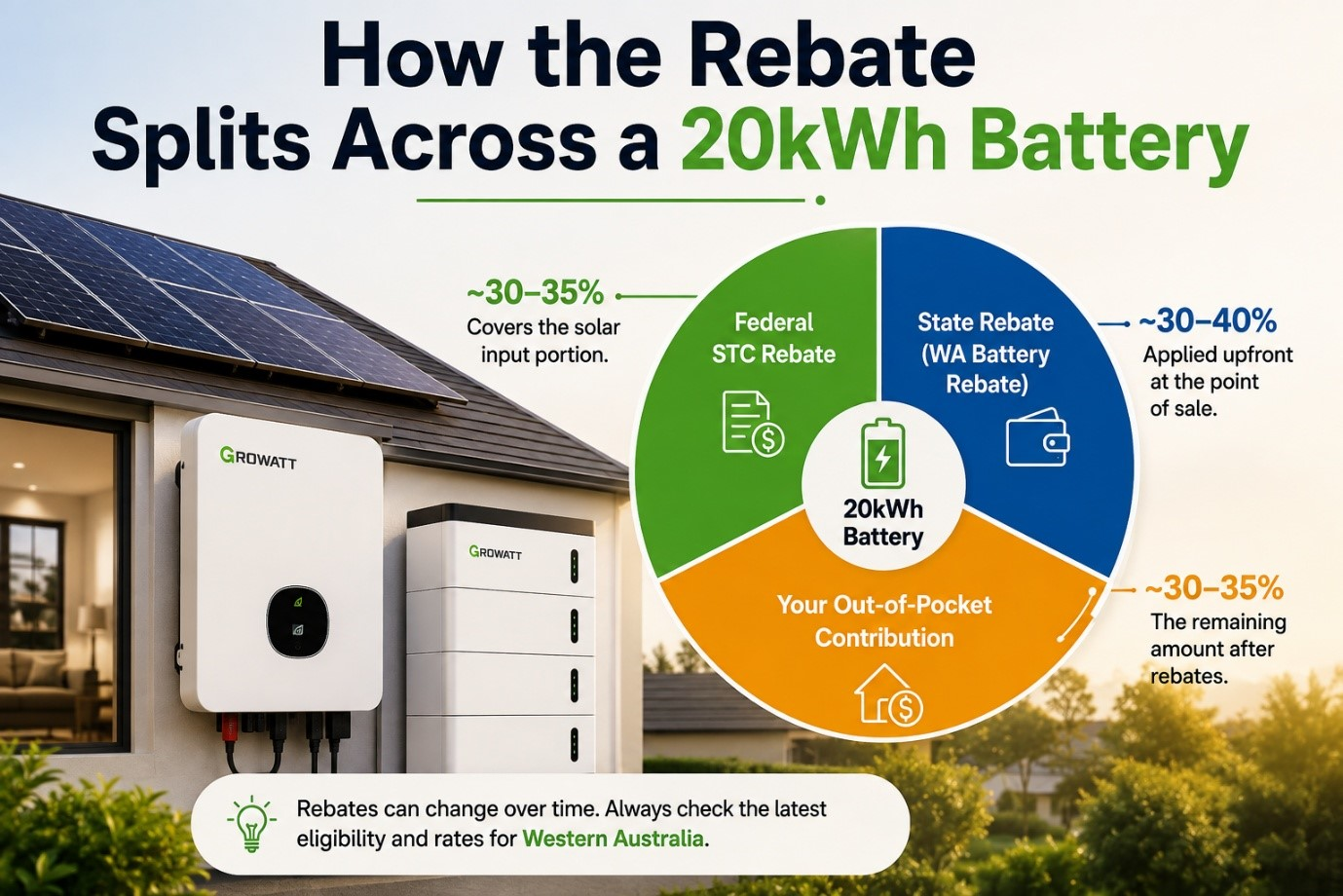
Unlike 28kWh, which sits exactly on a tier boundary, 20kWh lands inside the second tier — and that’s actually a reasonably efficient spot to be. Here’s the full tier structure, showing exactly where a 20kWh battery’s capacity stops within it:
Which Brands Offer 20kWh
| Brand | Range | Fit for 20kWh |
|---|---|---|
| BYD Battery-Box HVM | 8.1–22.1kWh (single unit) | Genuine single-unit fit |
| Growatt APX | 5–30kWh | Genuine single-unit fit |
| Alpha ESS SMILE M5 | 5–30kWh | Genuine single-unit fit |
| Sungrow SBR | 6.4–25.6kWh | Comfortable, mid-range |
| Sigenergy SigenStor | 5–48kWh per stack | Comfortable, early in stack |
| Fox ESS EQ4800 | ~10–40kWh+ | Comfortable, early-mid stack |
Three brands stand out here versus the 28kWh-and-up size class: BYD, Growatt, and Alpha ESS all offer 20kWh as a genuine single-cabinet product rather than needing an oversized multi-module stack — one footprint, one set of dimensions, sold and installed as the 20kWh option in their range. That can mean a simpler installation and a smaller overall footprint than reaching 20kWh by stacking more modules than the system is really designed around. For full specs, efficiency and warranty terms across these and three more brands, see our complete battery brand comparison.
Growatt 20kWh: The Space-Saving Choice for Perth Walls
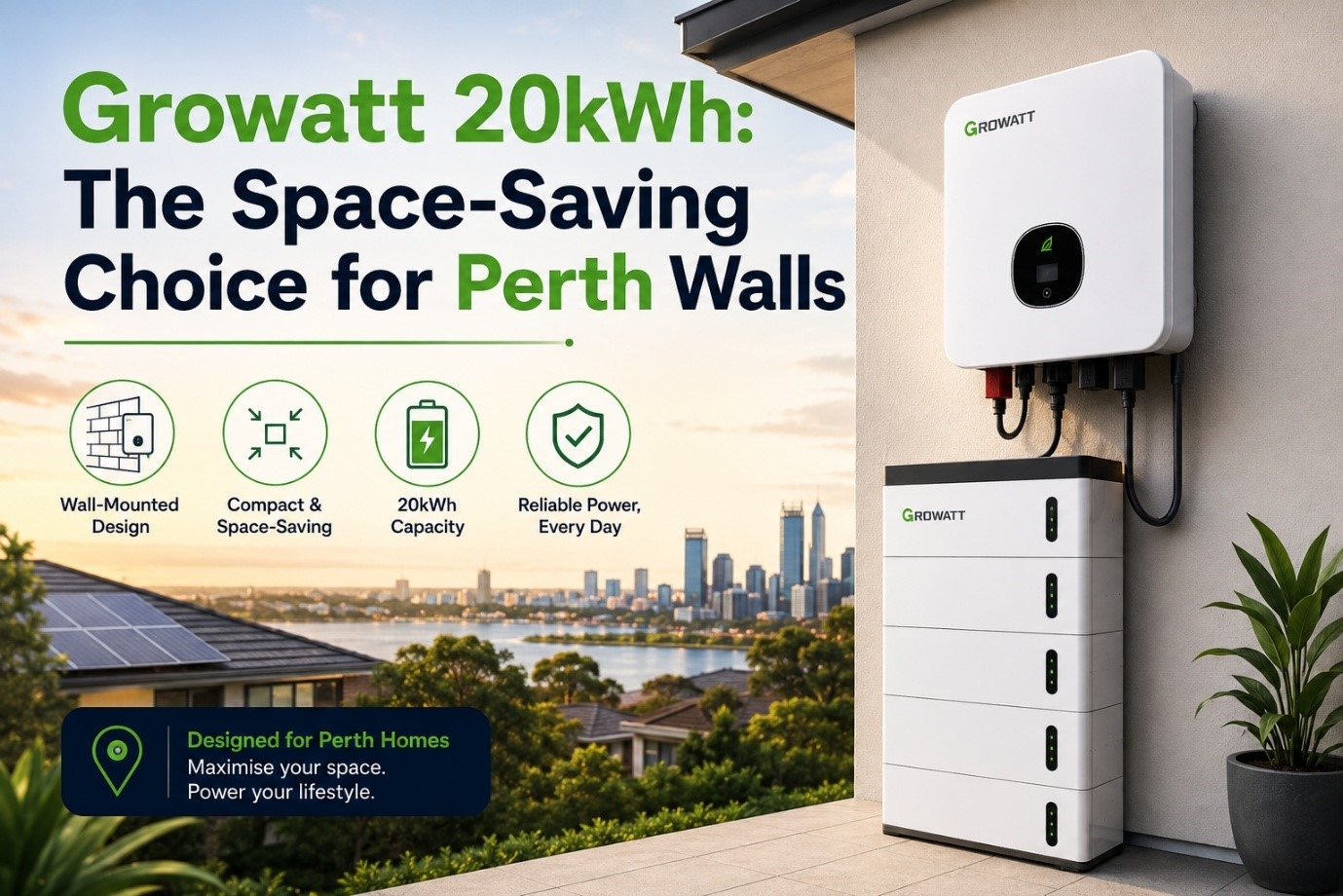
If wall space is tight — a narrow side passage, a garage already crowded with a switchboard and shelving — Growatt’s 20kWh configuration is worth a closer look specifically for its depth. At just 185mm deep, it sits noticeably flatter against the wall than most stacked battery systems, without giving up any of the 20kWh capacity this guide is about.
Clearance Requirements
- Minimum 600mm clearance on each side of the unit
- Location must not be near windows or ventilation openings into habitable rooms
- Location must not be near exit doors — keep evacuation paths clear
- These are general figures — final placement is always confirmed on-site against the current AS/NZS 5139 requirements covered in our battery brand comparison
Not sure if 20kWh fits your actual usage?
We’ll model it against your real bills before recommending a size — not just sell you a package number.
Get a battery sizing assessment20kWh vs 28kWh: Side by Side
Medium-large households
- Suits 4–6 people, solid evening use
- 70% of capacity at full rebate rate
- ~8–12kW solar array needed
- Fits as a single unit in several brands (BYD, Growatt, Alpha ESS)
Large, high-load households
- Suits 5+ people, pool pumps, ducted AC, EV
- 28kWh sits exactly on the tier boundary
- ~10–15kW+ solar array needed
- Typically a multi-module stack
Neither is universally “better” — see our 28kWh Solar Battery Perth guide for the full breakdown of when the bigger size actually earns its keep.
Solar Array Sizing for a 20kWh Battery
Using the same 1.3–2× usable capacity guideline covered in our other sizing guides, a 20kWh battery generally wants roughly 8kW to 12kW of solar behind it — noticeably less than the 10–15kW a 28kWh system needs. That smaller requirement is one of the practical advantages of this size class: it’s achievable on a wider range of Perth roofs without needing a very large or multi-orientation array.
Frequently Asked Questions
- How many people is a 20kWh battery suited to?
- A 20kWh battery generally suits medium to large households — commonly 4-6 people with solid evening usage, without necessarily needing the pool pump, ducted air conditioning, or EV charging load that pushes toward 28kWh instead.
- How does the federal rebate apply to a 20kWh battery?
- A 20kWh usable battery receives the 100% rebate rate on its first 14kWh and the 60% rate on the remaining 6kWh. Roughly 70% of the battery’s capacity earns the full rate, which is a notably better blended rebate return than a larger battery where more of the capacity falls into the lower tiers.
- Which battery brands offer 20kWh as a single unit?
- BYD Battery-Box HVM, Growatt APX, and Alpha ESS SMILE M5 all offer 20kWh as a genuine single-cabinet product rather than an oversized stack. Sungrow SBR also comfortably covers 20kWh within its 6.4-25.6kWh range. Sigenergy and Fox ESS reach 20kWh easily within a modular stack as well.
- How much solar do I need for a 20kWh battery?
- Using the standard 1.3-2 times usable capacity guideline, a 20kWh battery generally wants roughly 8kW to 12kW of solar behind it, depending on roof orientation, shading, and how much of the array faces the afternoon sun.
- Is 20kWh or 28kWh the better choice?
- 20kWh suits medium-large households with solid but not extreme evening usage, and returns a better blended rebate rate per kWh. 28kWh suits larger households with heavier loads like pool pumps, ducted air conditioning or EV charging, and sits exactly on the rebate’s tier boundary. Actual daily usage is the deciding factor, not household size alone.