In this guide
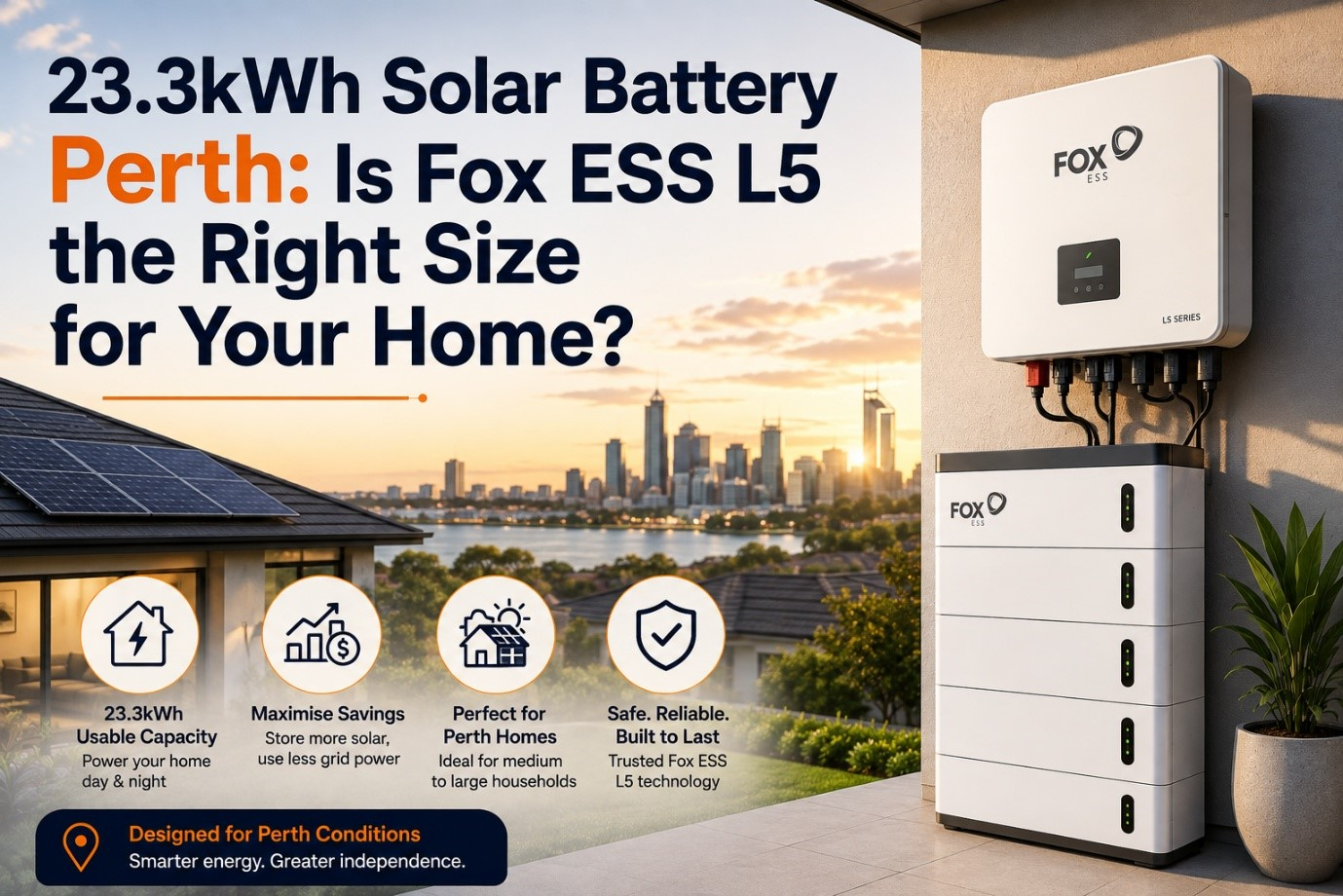
Most battery guides talk in round numbers — 20kWh, 28kWh, 30kWh — because most brands scale in round-ish steps. Fox ESS’s EQ4800 line doesn’t quite work that way: each module adds 4.66kWh, so the named configurations land on their own numbers. The L5 configuration — one master module plus four slave modules — lands at exactly 23.30kWh. It’s a genuine, factory-rated size sitting in the gap between the 20kWh and 28kWh classes most guides cover.
What 23.3kWh Actually Gives You
In practical terms, 23.3kWh sits comfortably above what a standard 10–13.5kWh system offers, without reaching the heavy-load territory a 28kWh system is built for. It can typically carry a household through a full evening peak window and overnight with room to spare — enough buffer for an unusually heavy evening (visitors, a big cook-up, longer air conditioning use) without needing to plan around it the way a tightly-sized 20kWh system might.
Who Actually Needs This Size
Good fit
4–6 person households with evening usage that regularly runs a bit higher than average — somewhere in the 18–23kWh/day range — who want more buffer than a 20kWh system without stepping up to 28kWh.
Worth modelling first
Households currently around 15–18kWh/day but expecting it to grow moderately — a bigger seasonal air conditioning load, a part-time EV charging routine, or a household size that’s about to increase.
Consider a different size
Under 15kWh/day usage — a 10–13.5kWh battery will likely return better value. Running a pool pump and ducted air conditioning together, or planning full-time EV charging — see our 28kWh guide instead.
How the Rebate Splits Across a 23.3kWh Battery
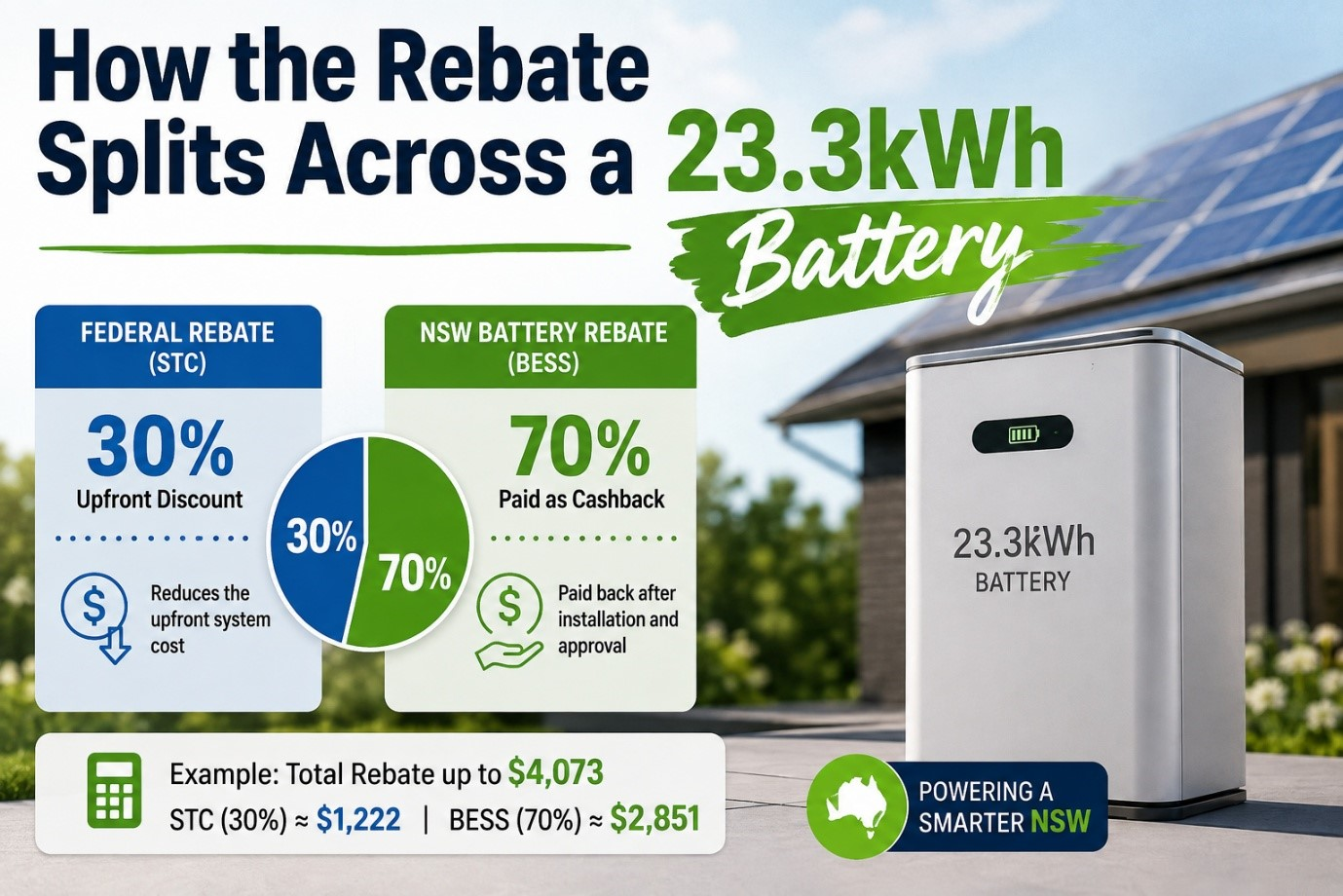
23.3kWh lands well inside the federal rebate’s second tier — not on a boundary like 28kWh, and not as deep into it as 20kWh. Here’s exactly where it sits:
Fox ESS EQ4800 L5: The Named 23.3kWh Configuration
The L5 is built from five modules — one master (which houses the battery management electronics) and four slave modules, each contributing 4.66kWh. That gives a factory nominal rating of 23.30kWh, not an estimate or a rounded marketing figure.
At 800mm tall, the L5 sits noticeably lower than the L6 configuration used in our 28kWh guide (938mm) — worth knowing if ceiling height or a specific wall position is a constraint. Same 570 × 380mm footprint either way, since Fox ESS’s EQ4800 stack grows in height as modules are added, not in floor space.
Clearance Requirements
- Minimum 600mm clearance on each side of the unit
- Location must not be near windows or ventilation openings into habitable rooms
- Location must not be near exit doors — keep evacuation paths clear
- At 200.5kg, lighter than the L6’s 239.5kg — still confirm your installer has planned appropriate wall-fixing or a floor-standing base
Not sure if 23.3kWh fits your actual usage?
We’ll model it against your real bills before recommending a size — not just sell you the nearest round number.
Get a battery sizing assessment23.3kWh vs 20kWh vs 28kWh: Side by Side
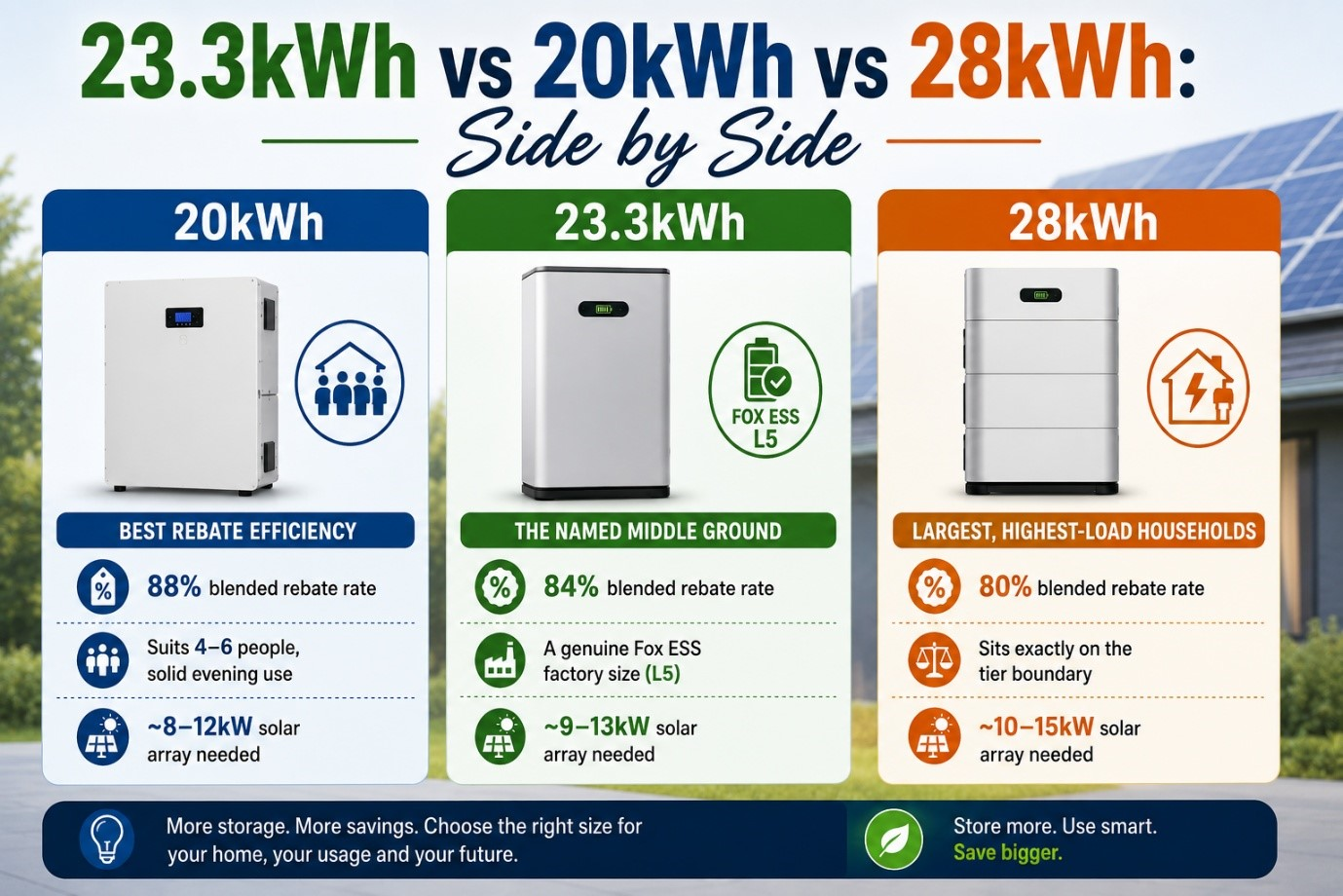
Best rebate efficiency
- 88% blended rebate rate
- Suits 4–6 people, solid evening use
- ~8–12kW solar array needed
The named middle ground
- 84% blended rebate rate
- A genuine Fox ESS factory size (L5)
- ~9–13kW solar array needed
Largest, highest-load households
- 80% blended rebate rate
- Sits exactly on the tier boundary
- ~10–15kW solar array needed
None of these is universally “better” — see our 20kWh guide or 28kWh guide for the full breakdown of when each size actually earns its keep. For the complete brand-by-brand comparison across footprint, efficiency and warranty terms, see our battery brand comparison.
Solar Array Sizing for a 23.3kWh Battery
Using the same 1.3–2× usable capacity guideline covered across our sizing guides, a 23.3kWh battery generally wants roughly 9kW to 13kW of solar behind it — between the 8–12kW a 20kWh system needs and the 10–15kW a 28kWh system needs. Fox ESS’s own H3 inverter range, scaling from 10kW single-phase up through the H3 Pro series, comfortably covers this range in a single inverter.
Battery ROI Calculator
Full breakdown of where your electricity actually comes from each day — direct solar use, battery-stored solar, grid draw, and export — not just a single savings figure. Pre-filled for a 23.3kWh Fox ESS L5 system; change any field to match your own numbers.
Is a Battery Worth It?
Enter your numbers and see your estimated daily and annual savings, plus payback time — with a full breakdown of where every kWh actually goes.
Frequently Asked Questions
- How many people is a 23.3kWh battery suited to?
- A 23.3kWh battery generally suits medium to large households — commonly 4-6 people with high evening usage, sitting between the typical 20kWh and 28kWh size classes. It suits homes that want more buffer than 20kWh offers without stepping up to a 28kWh, higher-load system.
- How does the federal rebate apply to a 23.3kWh battery?
- A 23.3kWh battery receives the 100% rebate rate on its first 14kWh and the 60% rate on the remaining 9.3kWh. It never reaches the lower 15% tier, which only starts at 28kWh. The blended rebate rate works out to roughly 84% of the full rate across the whole battery, ahead of a 28kWh system’s 80% but behind a 20kWh system’s 88%.
- What is the Fox ESS EQ4800 L5?
- The Fox ESS EQ4800 L5 is a named, factory-configured battery built from one master module and four slave modules (five 4.66kWh modules total), rated at 23.30kWh nominal energy. It measures 570mm wide, 800mm tall and 380mm deep, and weighs 200.5kg.
- How much solar do I need for a 23.3kWh battery?
- Using the standard 1.3-2 times usable capacity guideline, a 23.3kWh battery generally wants roughly 9kW to 13kW of solar behind it, depending on roof orientation, shading, and how much of the array faces the afternoon sun.
- Is 23.3kWh, 20kWh or 28kWh the better choice?
- 20kWh returns the strongest blended rebate rate and suits solid-but-not-extreme evening usage. 28kWh suits the largest, highest-load households and sits exactly on the rebate’s tier boundary. 23.3kWh sits between the two — a sensible step up from 20kWh for households that measure usage a bit higher, without the jump to a 28kWh system built around pool pumps, ducted air conditioning or EV charging.