
In this guide
What’s New for NSW Commercial Batteries
Until now, meaningful battery incentives in NSW were largely a household story. That changes on 1 September 2026, when the NSW Government expands its Peak Demand Reduction Scheme (PDRS) — part of the Energy Security Safeguard — to cover commercial-scale batteries for the first time, through two new activities: BESS4 and BESS5.
This isn’t a separate rebate program you apply for. It works through tradeable certificates, same underlying mechanism as the federal solar and battery schemes, just administered by IPART at the state level instead of the Clean Energy Regulator federally. For a business weighing up a battery, the practical result is real money off the upfront cost — NSW Government modelling shows roughly $44,100 for a 200kWh battery installed on its own, before any federal contribution.
The Roadmap: How This Actually Works
Before the detail, here’s the big picture two ways — first how the money physically moves, then a step-by-step path to work out which incentive applies to your project.
How the Money Flows
Which Incentive Applies to You
Single home → see BESS2 (VPP incentive). Apartment building, 4+ dwellings → see BESS3 below.
Not a residential building, not a data centre → continue to Step 2.
Battery-only install → BESS4 applies, standard rate.
Solar:battery ratio over 1:4 → BESS5 applies, higher rate.
Federal STCs remain available (full value up to 50kWh usable, capped from there).
Federal STCs stop completely — no partial entitlement above the cap.
≤100kWh → STCs + PDRS stack together. >100kWh → PDRS (BESS4/BESS5) only, uncapped.
PRC value is deemed upfront using: usable capacity (90% of nameplate) × activity coefficient × 6-hour peak window × 15-year deeming period × network loss factor. The higher BESS5 coefficient only applies when new solar is commissioned within 90 days of the battery and the kW:kWh ratio exceeds 1:4 — model both coefficients before quoting, since the difference materially changes the certificate count. Confirm the current activity coefficients against the live PDRS Rule before locking in a customer quote, as IPART revises these periodically.
How PDRS Certificates Work
PDRS doesn’t pay a fixed dollar rebate. Instead, an eligible battery installation generates Peak Reduction Certificates (PRCs) — each one represents a small amount of peak electricity demand reduction, and your installer or an Accredited Certificate Provider (ACP) creates and sells them on your behalf. The value gets passed back to you as a discount on the installed price, similar in spirit to how federal STCs work for solar and batteries, just a state-based certificate rather than a federal one.
BESS4 vs BESS5: Which Applies to You
| Activity | Covers | Incentive level |
|---|---|---|
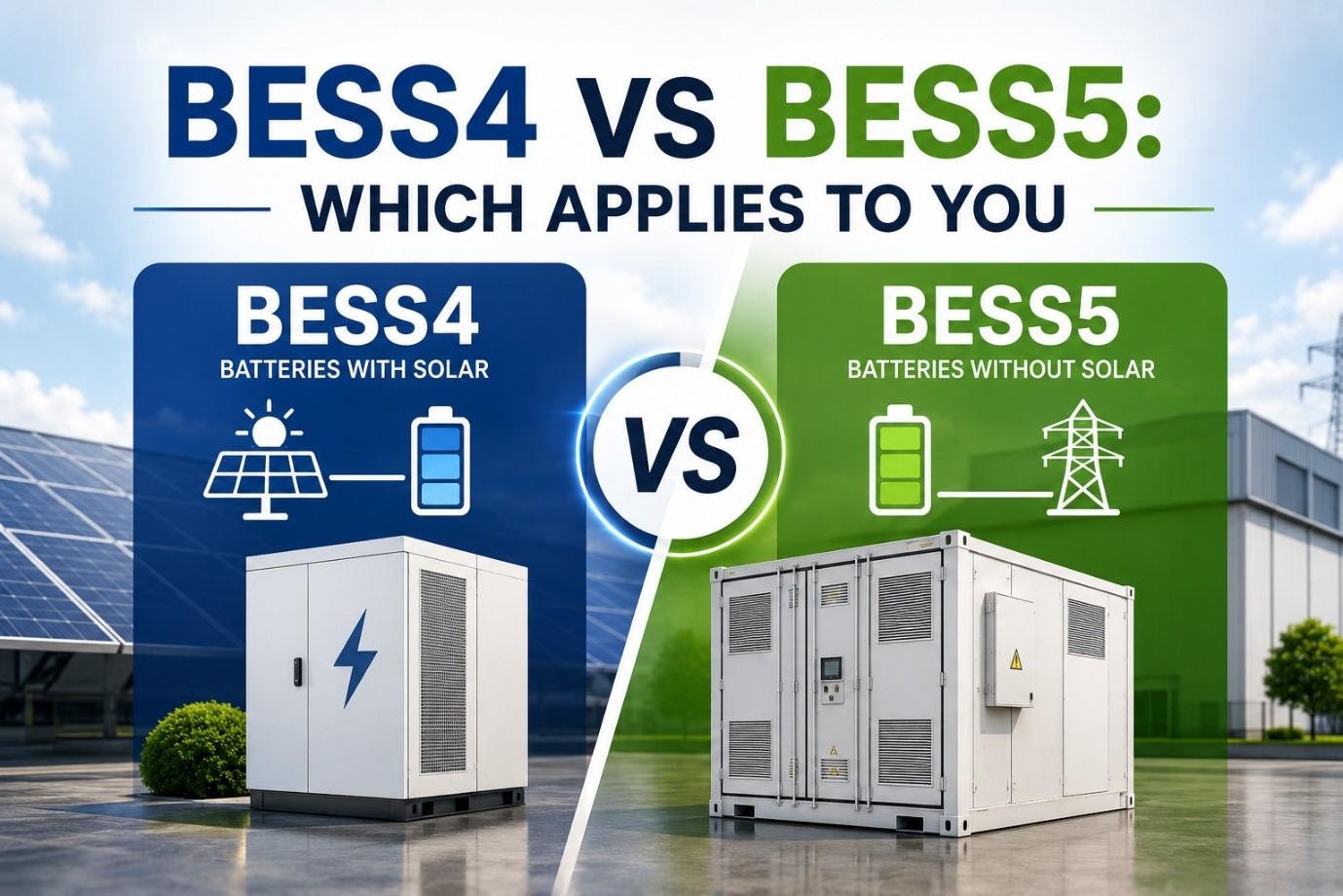
| BESS4 | Battery-only commercial installation | Standard rate |
| BESS5 | Battery installed with new solar PV | Higher rate |
Battery-only installs are eligible under BESS4 — you don’t need new solar to qualify. But if you’re installing new solar alongside the battery, BESS5 pays a higher incentive, on the condition that the new solar (kW) to battery (kWh) ratio is more than 1 to 4. Worth noting: PDRS doesn’t pay a direct incentive for the solar component itself — the uplift comes through the battery activity, not a separate solar certificate.
Both activities share the same baseline eligibility: the site can’t be a residential building or a data centre, and can’t have previously received a BESS4 or BESS5 incentive.
STCs vs PDRS: What Size Can You Actually Claim?
This is the question that trips up most quotes we see, so here’s the direct answer. Federal STCs (via the Cheaper Home Batteries Program) and NSW PDRS (BESS4/BESS5) are two separate, independent schemes — one federal, one state — and a NSW project can generally claim both. But each has its own size rules, and they don’t line up perfectly.
Under 50kWh usable capacity
Fully eligible for both. Federal STCs are calculated in full (subject to the tiering below), and BESS4/BESS5 apply on top. This is the sweet spot — every kWh is earning value from both schemes.
50kWh–100kWh nominal capacity
Still eligible for both schemes, but the federal STC value stops growing. STCs are only calculated on the first 50kWh of usable capacity — a 50kWh system and a 90kWh system receive the same federal STC value, because the extra capacity above 50kWh simply doesn’t generate more certificates. PDRS, by contrast, keeps scaling with the full battery size.
Over 100kWh nominal capacity
No federal STCs at all — the Cheaper Home Batteries Program has a hard cutoff at 100kWh nominal capacity, and there’s no partial or reduced entitlement above it. NSW PDRS keeps applying on its own, uncapped by that federal threshold — this is exactly the scenario behind the government’s own $44,100-on-a-200kWh-battery modelling.
Quick Eligibility Calculator
Enter a battery size to see which scheme(s) it’s likely eligible for. This is a guide to eligibility rules, not a certificate-price quote — get in touch for exact numbers on your site.
STC / PDRS Eligibility Checker
Not sure what your project qualifies for?
We’ll model both schemes against your actual site and battery size — not just the headline percentage.
Get a commercial battery quoteWorked Examples
| Battery size | Federal STCs | NSW PDRS | Stacked? |
|---|---|---|---|
| 35kWh, battery only | Yes — full value | BESS4 | Yes |
| 35kWh, with new solar (10kW+) | Yes — full value | BESS5 (higher rate) | Yes |
| 90kWh, battery only | Yes — capped at 50kWh usable | BESS4 — scales with full 90kWh | Yes |
| 200kWh, battery only | No — exceeds 100kWh cap | BESS4 — full value, no cap | PDRS only |
The 90kWh case is the one worth sitting with: two businesses installing 90kWh and 50kWh batteries receive the same federal STC discount, because STCs stop accruing at 50kWh usable capacity. The larger system only pulls ahead once PDRS is counted — which is exactly why sizing a commercial battery around STCs alone, without checking the PDRS side, tends to undersell what a bigger system is actually worth.
Apartment Buildings Get Their Own Activity: BESS3
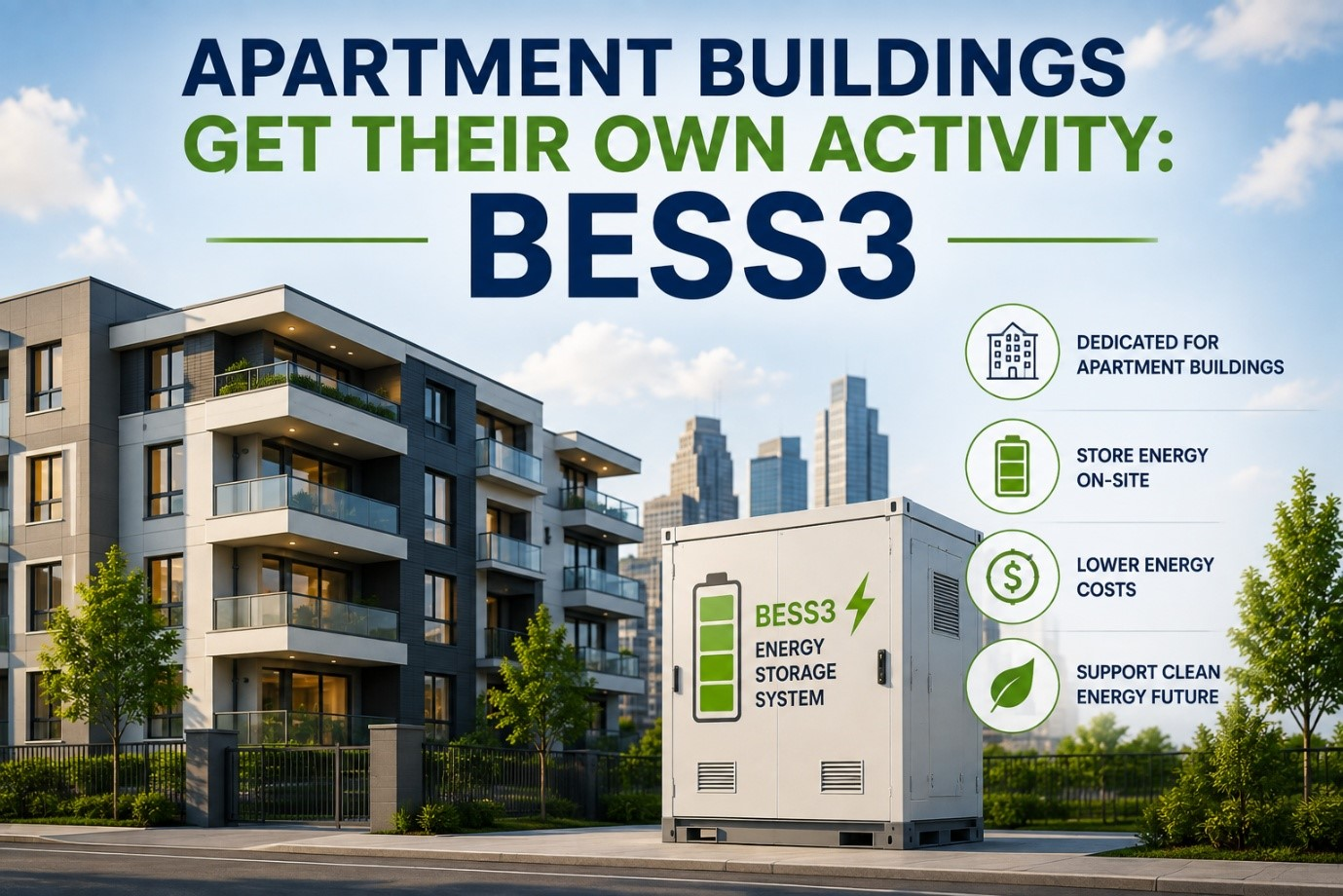
If you manage or own a strata building rather than a standalone business site, the relevant activity is BESS3, not BESS4/BESS5. Buildings with more than four dwellings and no existing battery can access a rebate for one shared battery system, sized between 20kWh and 200kWh, capped at 5kWh per dwelling. Like the commercial activities, it can stack with federal STCs up to the same 100kWh ceiling.
Eligibility Checklist
- Site must be in NSW and connected to the NSW electricity grid.
- Site must not be a residential building (single dwelling) or a data centre, for BESS4/BESS5.
- Battery and inverter must be on the approved product list at time of installation.
- Installation must occur on or after 1 September 2026 for BESS4/BESS5 (or 1 July 2025 for federal STC eligibility).
- Battery must be internet-connectable and controllable by a demand-response aggregator — a hardware capability, not necessarily an active VPP contract.
- Site must not have previously received a BESS4 or BESS5 incentive.
- For federal STC stacking specifically: nominal capacity must sit within 5–100kWh.
This list covers the headline conditions — the full PDRS Rule has additional technical detail on metering, aggregator agreements and certificate creation that your installer should walk through project by project.
Frequently Asked Questions
- What size battery can claim federal STCs?
- Any battery between 5kWh and 100kWh nominal capacity is eligible for federal STCs under the Cheaper Home Batteries Program. Within that range, the STC discount is only calculated on the first 50kWh of usable capacity — a bigger system doesn’t earn more STC value beyond that point, though it remains eligible up to 100kWh nominal.
- Can a business claim both STCs and NSW PDRS for the same battery?
- Yes, for systems up to 100kWh nominal capacity. Federal STCs and NSW PDRS (BESS4 or BESS5) are separate, independent schemes covering the same equipment, and can generally be claimed together on eligible systems.
- What happens if a commercial battery is over 100kWh?
- A battery over 100kWh nominal capacity is not eligible for any federal STCs at all — the Cheaper Home Batteries Program has a hard 100kWh eligibility ceiling. It can still claim NSW PDRS (BESS4 or BESS5) on its own, since PDRS does not share that same cap.
- What is the difference between BESS4 and BESS5?
- BESS4 covers battery-only commercial installations. BESS5 applies where new solar PV is installed alongside the battery, and pays a higher incentive, provided the new solar (kW) to battery (kWh) ratio is more than 1 to 4.
- When does the NSW commercial battery rebate start?
- BESS4 and BESS5 apply to installations from 1 September 2026 onward. Eligibility is assessed against the PDRS Rule in force at the time of installation.
- Can apartment buildings get a battery rebate in NSW?
- Yes, under a separate activity called BESS3. Buildings with more than four dwellings and no existing battery can access a rebate for a shared battery system sized between 20kWh and 200kWh, capped at 5kWh per dwelling, and this can also stack with federal STCs up to 100kWh.