
In this guide
- How a home battery works
- Do you need solar first
- Why a local specialist
- Why a battery saves money
- Interactive ROI calculator
- What size battery you need
- What size solar to support it
- Choosing a battery brand
- Placement & dimensions
- The WA state rebate
- The federal rebate
- Stacking both rebates
- Interest-free finance
- The VPP requirement
- Our installation service
- More guides
- FAQs
- Sources
Most battery content online covers one piece of the decision — a rebate explainer here, a brand comparison there, a sizing rule of thumb somewhere else. This guide puts the whole thing in one place: what a battery actually does, how to size it correctly, which brand fits your setup, where it physically has to go, and every dollar of support available to a WA household right now, stacked together with real numbers.
How a Home Battery Actually Works
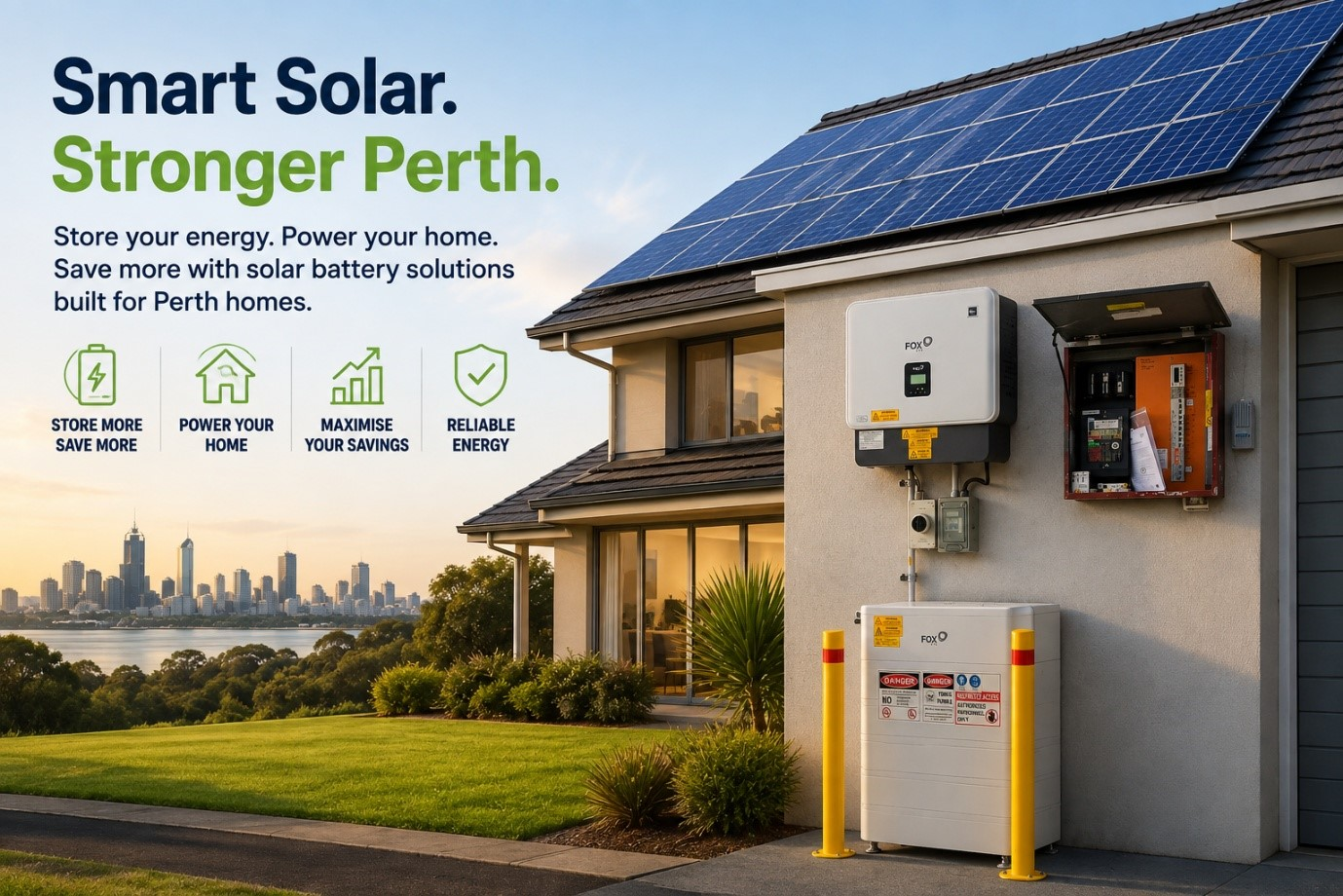
A home battery sits between your solar panels, your switchboard, and the grid, and does one job: store electricity when it’s cheap or free, and release it when it would otherwise cost you money. The three components that matter:
The inverter
- Converts DC solar power to AC for your home
- A hybrid inverter manages both solar and battery in one unit — most new installs use this
- An AC-coupled setup adds a battery to existing solar via a second inverter — common for retrofits
The CT clamp / smart meter
- Measures how much power your home is drawing from the grid
- Tells the inverter when to charge, discharge, or hold
- Gets this wrong and the whole system misbehaves — see our CT metering guide for the technical detail
During the day, solar panels generate more power than most homes use. Without a battery, that excess gets exported to the grid for a small feed-in credit. With a battery, the excess charges the battery first — and only spills over to export once the battery is full. In the evening, instead of buying grid power at the full import rate, the home draws down the stored solar until the battery empties, at which point it falls back to the grid automatically.
Do You Need Solar Panels First?
Technically, no
A battery can be installed and charged directly from the grid, using cheaper off-peak electricity to fill it and discharging during expensive periods. This is sometimes called “grid arbitrage.”
Financially, almost always yes
Without solar, you’re paying for every kWh that goes into the battery — just at a cheaper time of day. With solar, a large share of what fills the battery is electricity you generated for free and would otherwise have sold back to the grid for very little. That’s the difference between a battery that pays for itself in a reasonable timeframe and one that barely breaks even.
If you’re adding a battery to an existing solar system, see our guide on choosing the right battery for your existing setup.
Why It’s Worth Talking to a Perth-Based Specialist
A search for “solar battery Perth” turns up a genuine mix of installers — some are Perth-based, others are national operators with a call centre and a fly-in crew. Both can do a competent install. The practical difference shows up afterwards.
What local actually gets you
- An installer who deals with Synergy and Horizon Power applications daily, not occasionally
- A technician who can attend a warranty callout without a flight booking
- Familiarity with WA-specific compliance rules (Western Power grid connection, acreage boundary metering, local council requirements)
Worth asking any installer
- Are you CEC and SAA accredited specifically for battery installation, not just solar?
- Who attends if something needs fixing after install — the same installer, or a subcontracted network?
- Do you handle both the WA rebate and the federal rebate paperwork, or just one?
Solar Red is based in Osborne Park and installs across Perth and WA — CEC and SAA accredited, NECA member, with the same installers handling your quote, your install, and your aftercare.
Why a Battery Actually Saves You Money
The mechanism is the same for every Synergy customer on a standard plan, and it comes down to the gap between two numbers:
| Rate | What it means | Approximate figure |
|---|---|---|
| Grid import rate | What you pay per kWh bought from the grid | ~31.6c/kWh |
| Solar feed-in rate | What you’re paid per kWh of spare solar exported | ~2–10c/kWh |
Without a battery, spare solar generated during the day gets sold back to the grid at that low feed-in rate. Then, once the sun goes down, the same household buys electricity back from the grid at the much higher import rate — effectively selling cheap and buying back expensive, on the exact same electricity, most days of the year.
Under WA’s DEBS (Distributed Energy Buyback Scheme), export rates vary by time of day — currently around 10c/kWh during the 3–9pm peak window and roughly 2c/kWh off-peak. That peak-period export rate is still well below the ~31.6c/kWh import rate, so the gap a battery closes holds up even during the highest-value export window.
Battery ROI Calculator
Full breakdown of where your electricity actually comes from each day — direct solar use, battery-stored solar, grid draw, and export — not just a single savings figure. Pre-filled with typical Perth household numbers; change any field to match your own bill and system.
Is a Battery Worth It?
Enter your numbers and see your estimated daily and annual savings, plus payback time — with a full breakdown of where every kWh actually goes.
What Size Battery Do You Actually Need
Sizing a residential solar battery correctly is the single biggest factor in whether it earns its keep. The most common mistake is matching the battery to total daily usage.
The number that actually matters is evening and overnight usage — what you draw from the grid after the sun stops generating, since that’s the only window a battery can realistically cover.
| Household pattern | Typical size | Notes |
|---|---|---|
| Smaller household, moderate evening use | 10–13kWh | Common entry-level sweet spot |
| Family household, standard usage | 13–20kWh | Covers most evening/overnight patterns |
| Larger household, EV or heat pump hot water | 20–28kWh | Where federal rebate tiering starts to matter most |
For a detailed look at specific sizes, see our dedicated guides on 20kWh, 23.3kWh, and 28kWh systems, including the rebate math for each.
What Size Solar System Supports It
A battery is only as useful as the solar generation available to fill it. In Perth, a well-oriented, unshaded system generates roughly 5.3kWh per kW of installed panels per day on average across the year — less in winter, more in summer.
Undersized solar means the battery rarely reaches full charge, leaving stored capacity unused most evenings — the single biggest reason a correctly-sized battery still under-delivers on savings. If you’re adding a battery to existing solar, it’s worth checking your system’s actual generation history against your target battery size before committing.
Choosing a Battery Brand
Solar Red installs across six major brands, each with a different sweet spot depending on your inverter, budget, and expansion plans.
| Brand | Common capacity range | Where it tends to fit best |
|---|---|---|
| Fox ESS EQ4800 | ~10kWh to 40kWh+ (single stack) | Compact vertical stacking, strong rebate-tier fit at 20/23.3/28kWh |
| Growatt APX | 5kWh to 30kWh | Narrowest footprint, mixes old/new modules in one stack |
| GoodWe Lynx Home F | 6.6kWh to 16.4kWh | Best when paired with a compatible GoodWe hybrid inverter |
| Alpha ESS SMILE M5 | 5kWh to 30kWh | VPP-preferred, proven install volume in WA |
| Tesla Powerwall 3 | 13.5kWh per unit | Fixed capacity, polished app monitoring, strong backup features |
| Jinko Solar | Varies by series | Panel and battery from one manufacturer for a unified warranty |
Why Fox ESS Comes Up So Often in Our Sizing Guides
Fox ESS’s EQ4800 module is exactly 4.66kWh — five modules make 23.3kWh, six make 27.96kWh — which lines up unusually well with the federal rebate’s tier boundaries. That’s not a coincidence we can claim credit for, but it’s why you’ll see Fox ESS as the hero brand across several of our size-specific guides.
Full brand-by-brand detail, including which inverters each pairs with and what “compact and easy to expand” actually means in practice, is in our battery brand comparison guide.
Placement & Dimensions
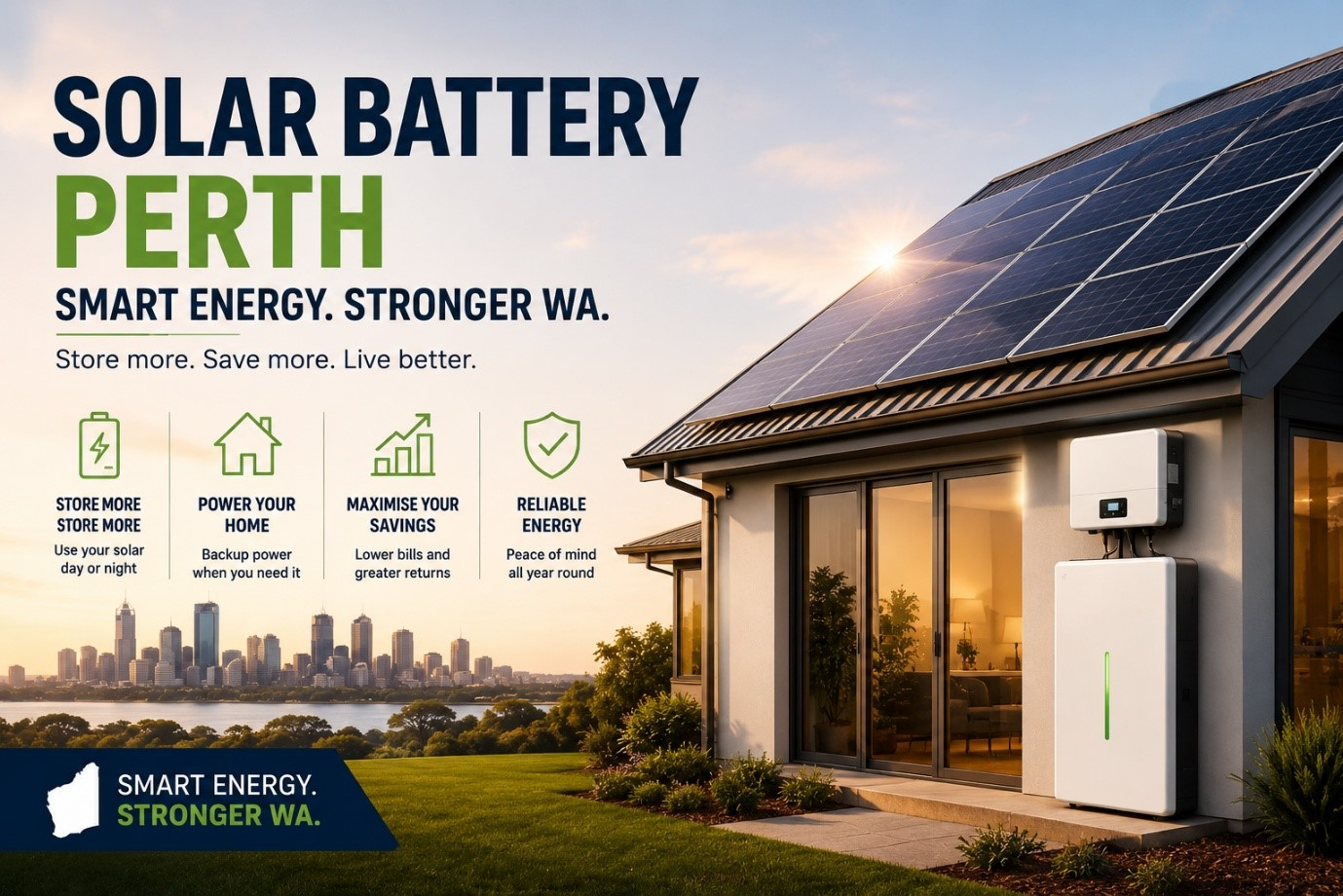
Most residential batteries are IP65-rated for outdoor use, which opens up more placement options than people expect — but “rated for outdoor” doesn’t mean “suited to any outdoor spot.”
Good placement
- Garage or carport wall, sheltered from direct sun and rain
- External wall under an eave, close to the switchboard
- Vertical, structurally sound mounting surface
- Clear access for future servicing
Worth checking
- Manufacturer clearance requirements — varies by brand and model
- Ambient temperature range at the site — direct summer sun on a north wall affects performance
- Cable run length back to the switchboard and inverter
- Council or strata approval for external installations, where applicable
On larger blocks, the battery’s ideal location and the property’s main switch aren’t always close together — it’s not unusual for a battery to sit in a shed or pool house while the main switch and metering point are 20–30 metres away in a separate structure. That’s a normal layout on acreage properties, not a sign something’s been installed incorrectly — see our guide to finding the switch on larger properties for a real example.
The WA Residential Battery Scheme
WA’s state battery rebate is administered per usable kWh, with a different rate and cap depending on which network you’re on.
| Network | Rebate rate | Cap (at 10kWh) |
|---|---|---|
| Synergy (Perth metro, Mandurah, Bunbury, Albany, Geraldton — SWIS network) | $130 per usable kWh | $1,300 |
| Horizon Power (regional and remote WA) | $380 per usable kWh | $3,800 |
Full eligibility detail, how the rebate is applied at point of sale, and what documentation your installer needs is in our dedicated WA rebate guide.
The Federal Cheaper Home Batteries Program
Unlike the state rebate, the federal Cheaper Home Batteries Program applies right across Australia, and its structure changed on 1 May 2026 to a tiered rate rather than a single flat percentage.
| Capacity band | Rebate rate |
|---|---|
| Up to 14kWh usable capacity | 100% of the standard rate |
| 14kWh to 28kWh usable capacity | 60% of the standard rate on the portion above 14kWh |
This is exactly why battery size sits so close to those tier boundaries in our size-specific guides — a system sized just under or over 14kWh, or scaled up toward 28kWh, sees a materially different blended rebate rate. The federal rebate is applied as an upfront discount by your installer, the same way it works in every other state.
Stacking Both Rebates: A Worked Example
Both rebates apply to the same system and are calculated independently, then combined into a single upfront reduction before finance is considered.
State rebate: $130 × 10kWh (capped) = $1,300
Federal rebate: applied at 100% up to 14kWh usable capacity — the full 13kWh qualifies at the standard rate
Both are deducted from the system price before any interest-free finance covers the remainder.
The exact federal dollar figure depends on the standard rate published for the relevant period, which your installer applies at quote stage — but the order is always the same: state rebate and federal rebate both reduce the price first, and finance covers whatever’s left.
Interest-Free Finance: The Plenti Loan
Once both rebates have reduced the price, Plenti — the WA Government’s appointed finance provider for the Residential Battery Scheme — can finance the remaining balance at 0% interest.
The numbers
- Loan amount: $2,001 to $10,000
- Term: 3 to 10 years, your choice
- Interest: 0%, fixed for the full term
- No early repayment fees
Eligibility basics
- Combined household income up to $210,000
- 6-month conditional approval window
- Minimum 2-year VPP enrolment commitment
- Applied for after the state rebate, as a second stage
See exactly how the Plenti application works
Screen-by-screen walkthrough, income document checklist, myGov steps, and the credit check explained.
Read the full finance guideThe VPP Requirement
Both the WA state rebate and the Plenti loan require enrolling the battery in an eligible Virtual Power Plant (VPP) — Synergy Battery Rewards or Horizon Power’s Community Wave, depending on your network — for a minimum 2-year term.
Full detail on how VPP enrolment works alongside the loan application is covered in our Plenti finance guide.
Our Solar Battery Installation Service
Solar Red’s residential solar battery Perth installation service covers the full process end to end — quoting, rebate and finance paperwork, the physical install, commissioning, and ongoing support. Here’s what installation day itself actually involves:
Recent Solar Battery Installations Around Perth
What’s included
- Site assessment and system design
- State and federal rebate paperwork, handled for you
- Finance application support if using Plenti
- Full commissioning and VPP enrolment
Service area & support
- Perth metro and greater Western Australia
- CEC and SAA accredited installers, not subcontracted
- Manufacturer warranty support handled locally
- Ongoing system monitoring and after-install support
Get a battery quote built around your actual usage
We size the system to your real evening draw and existing solar — not a generic package.
Get a free quoteExplore More Solar Red Guides
Frequently Asked Questions
- Do I need solar panels before I can get a battery?
- No — a battery can be installed on its own and charged from the grid, but it makes far less financial sense that way. Batteries earn their keep by storing cheap solar you’d otherwise export for very little, then using it at night instead of buying grid power at a much higher rate. Without solar, you’re just paying to charge a battery from expensive grid electricity, which rarely pays for itself.
- What size battery do I actually need?
- Look at your evening and overnight electricity use, not your total daily use. A battery that covers what you draw from the grid after the sun goes down is usually the right size — oversizing it means paying for capacity you rarely cycle. Most Perth households land somewhere between 10kWh and 20kWh, though larger households or those running EVs and heat pump hot water can justify going bigger.
- How big does my solar system need to be to support a battery?
- As a rule of thumb, your solar system’s daily generation should comfortably exceed your daily usage plus what’s needed to fully charge the battery, with some left over to export. In Perth, a well-oriented system generates roughly 5.3kWh per kW of panels per day on average across the year, which is the starting point for sizing solar around a specific battery.
- How much can I save with a home battery in WA?
- It depends on your usage pattern, tariff, and system size, but the underlying mechanism is the same for every Synergy customer: without a battery, spare solar exports for a low feed-in rate, then gets bought back at night at a much higher import rate. A battery closes that gap by storing your own solar for your own use instead of selling it cheap and buying it back expensive.
- Where does a home battery actually go?
- Most battery brands are IP65-rated for outdoor use, commonly mounted in a garage, carport, or an external wall with weather protection. Key requirements are a stable vertical wall, adequate clearance for ventilation and servicing, protection from direct sun and driving rain even on IP-rated units, and proximity to the switchboard and inverter to keep cable runs manageable.
- How much is the WA battery rebate?
- Synergy customers get $130 per usable kWh, capped at $1,300. Horizon Power customers get $380 per usable kWh, capped at $3,800. Both caps apply at 10kWh of usable capacity — batteries larger than that don’t earn additional state rebate on the extra capacity.
- Can I use the WA rebate and the federal rebate together?
- Yes. The WA Residential Battery Scheme and the federal Cheaper Home Batteries Program are separate schemes and stack together. Your installer applies both to the same system, reducing the upfront cost before any interest-free finance is applied to what’s left.
- Is there interest-free finance available for a battery in WA?
- Yes, through Plenti, the WA Government’s appointed finance provider for the Residential Battery Scheme. Loans run from $2,001 to $10,000 at 0% interest over a term of 3 to 10 years, with no early repayment fees. Approval requires enrolling the battery in an eligible Virtual Power Plant for a minimum 2-year term.
Sources & Further Reading
- WA Government: Residential Battery Scheme — Information for Applicants
- Synergy: Battery Rewards Program Terms
- Plenti: WA Residential Battery Scheme
- Solar Red: WA Battery Rebate Explained
- Solar Red: WA Interest-Free Battery Loan Guide
- Solar Red: Battery Brand Comparison
- Solar Red: CT Metering & Installation Guide