
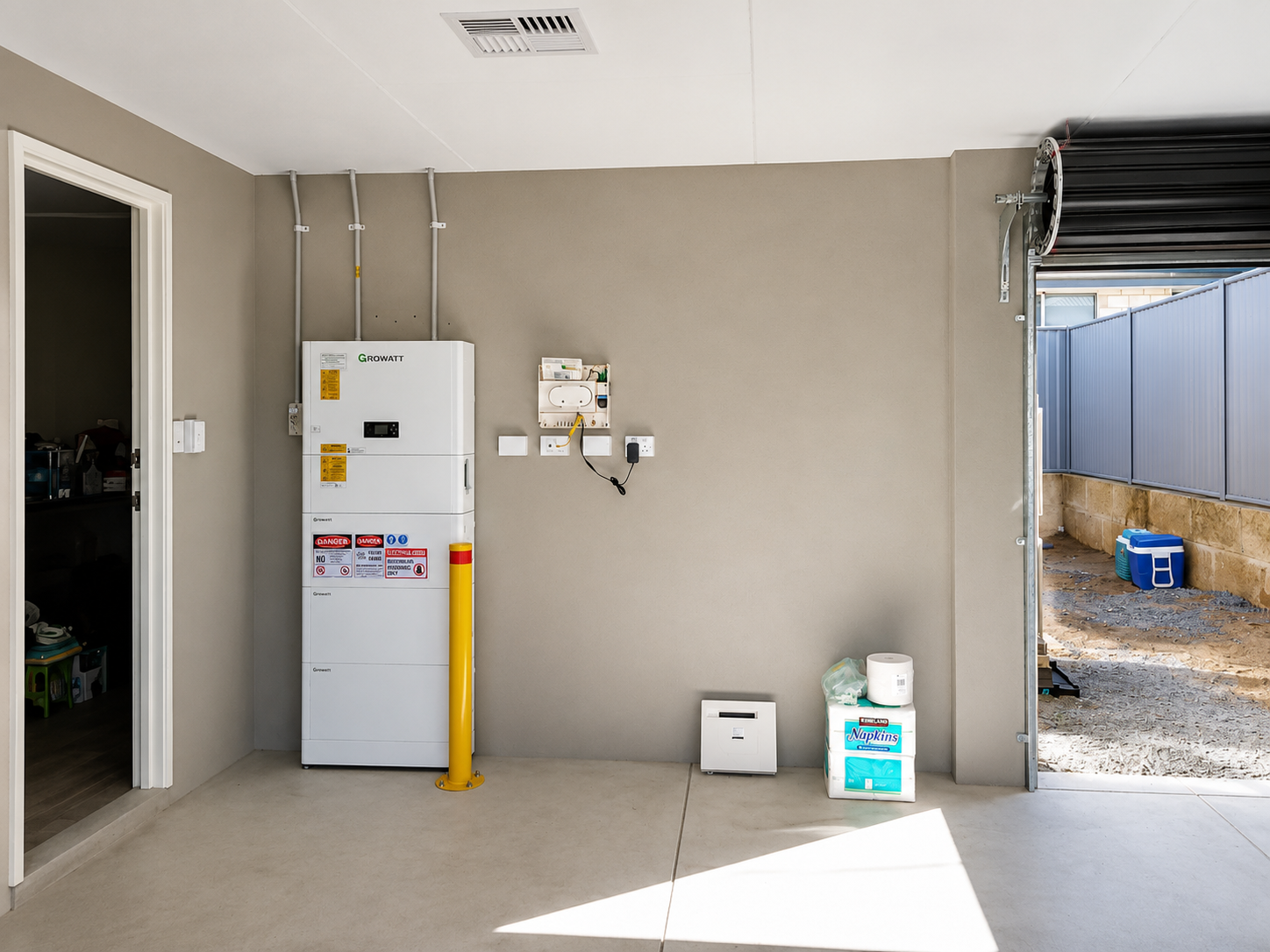

Battery placement in Australia is set by the battery standard, AS/NZS 5139, plus each manufacturer’s installation manual. Your installer makes the final call on site. This guide explains the rules in plain English so you can picture where yours will go, and why we sometimes suggest a different spot from the one you first had in mind.
The best spots in a Perth home
Garage wall
Our first choice. It’s shaded, dry, out of the weather and usually close to the meter box. Because cars park there, we install a bollard in front so the battery can’t be hit.
Shaded outside wall
An outside wall with a garage, laundry or store room behind it works well. South- and east-facing walls, or anything under a deep eave or patio roof, stay coolest in Perth summers.
Carport or a wall in the sun
Still possible. We add a shade canopy against afternoon sun. If there’s no solid wall, such as only a fence, a simple steel frame can be built for the battery to mount on.
Where a battery can’t go
These rules exist for one reason: a battery stores a lot of energy, so it’s kept away from where people sleep and live, and away from anything that could block an escape route in an emergency.
The clearance zones
Around the battery there’s a zone that must stay clear of anything that could start a fire or that people need to get through. The distances below are the ones commonly applied under AS/NZS 5139; some batteries need more, so your installer always checks the manual.
Your wall matters
Good news for most Perth homeowners: double brick is ideal. Batteries need a non-combustible surface behind them. If your wall is timber or plasterboard, we fit a fibre cement sheet behind the battery first.
| Wall or surface | Battery straight on it? | What we do |
|---|---|---|
| Brick or double brick | Yes | Mount directly |
| Concrete or block | Yes | Mount directly |
| Fibre cement sheet | Yes | Mount directly |
| Timber frame or weatherboard | No | Fit fibre cement sheet behind the battery |
| Plasterboard (e.g. inside garage) | No | Fit fibre cement sheet behind the battery |
| Colorbond or timber fence | No | Build a free-standing steel frame |
| Soil, grass or gravel underneath | No | Pour a small concrete slab |
Perth-specific checks
Anatomy of a Fox ESS install
Most of our Perth jobs use the Fox ESS hybrid inverter with the CQ7 stackable battery. Here’s what you’ll actually see on your wall, and why each part is there.
Hybrid inverter. Runs your panels and battery from one box, mounted at eye level on the wall.
Isolators. Labelled switches so the system can be shut down safely.
Conduit. Battery and AC cables run neatly inside grey conduit, never loose.
CQ7 battery stack. 6.96 kWh modules stacked on a base. Add more later if you need them.
Safety labels. Required warning and shutdown signs on the battery.
Bollard. Bolted to the slab wherever a car could reach the battery.
Solid base. Concrete slab or pavers, or a raised brick plinth. Never soil or gravel.
How much room you need
Batteries are slimmer than most people expect. Here are the footprints of two batteries we install most often, from the manufacturers’ Australian datasheets.
| Battery | Width × depth | Height | Clear wall to allow |
|---|---|---|---|
| Fox ESS CQ7 (6.96 kWh per module) | 660 × 360 mm | About 155 mm per module, plus the base (a 4-module stack is about 730 mm), with the inverter on the wall above | About 1.9 m wide |
| GoodWe ESA all-in-one (inverter on top) | 800 × 270 mm | 326 mm per battery module plus 300 mm inverter (about 1.6 m for four modules) | About 2 m wide |
Clear wall width allows 600 mm either side. Final layout is set by your installer to the manufacturer’s manual.
Real Solar Red installs
Every home is different. Here are two recent Fox ESS installs and why we placed them where we did.

- Fox ESS hybrid inverter
- AC isolator
- Cables in conduit
- CQ7 battery stack
- Bollard: cars park here
- Raised brick plinth keeps it off the ground

- Fox ESS hybrid inverter
- Cables in conduit
- CQ7 battery stack
- Bollard in front
- Adjustable feet on a level slab


What to photograph for a quote
We assess every battery spot before we quote, so nothing changes on install day. Send us these four photos and we’ll confirm the location, and anything it needs, on your quote.
The wall where you’d like it
Stand back about 3 metres so we can see the space, any windows, doors, taps or gas nearby.
Your meter box, door open
One clear photo of everything inside, plus one of the whole box from a step back.
Your existing inverter and its label
If you already have solar, this tells us what we’re replacing.
Both pages of your latest power bill
This is how we size the battery to your actual export and usage.
Frequently asked questions
- Can a home battery go inside the house?
- Not in a habitable room. Bedrooms, living areas, kitchens and hallways are off limits under AS/NZS 5139, and so are roof spaces and wall cavities. A garage, or an outside wall with a non-habitable room behind it, is the usual spot.
- Is my garage a good place for a battery?
- Usually the best place in a Perth home. It’s shaded, dry and often close to the switchboard. Because cars park there, we fit a bollard in front so the battery can’t be hit.
- Can a battery go on a west-facing wall in Perth?
- It can, but Perth afternoon sun is harsh and heat shortens battery life. If the only spot gets direct sun, we add a shade canopy, or we find a shadier wall.
- Can a battery be mounted on a fence?
- No. A Colorbond or timber fence can’t carry the weight and is often a shared boundary. If that’s the spot you want, a simple steel frame can be built in front of the fence and the battery mounted to that.
- How far does the battery need to be from my gas meter or gas bottle?
- We keep batteries at least 1 metre from gas, and further from gas bottles and gas hot water systems. Your installer confirms the exact distance on site.
- Does the battery need wi-fi where it’s installed?
- Yes. The WA battery rebate requires the battery to join a Virtual Power Plant, and new WA systems must be able to talk to the grid online. Check your wi-fi reaches the spot, or tell us so we can plan for it.
- What if my battery spot is far from the switchboard or on a shed?
- If everything is on the house and within about 20 metres of the switchboard, the inverter’s built-in meter is fine. For sheds, pole meters or longer distances we fit a wireless CHINT meter on your main switchboard, so the battery still covers the whole property.
Not sure where your battery should go?
Send us your photos and we’ll tell you the best spot, and what it needs, before you commit to anything. Local Perth installers, Plenti-approved for the WA rebate and interest-free loan.
Call 1800 449 733Send us your photosKeep reading
Sources: AS/NZS 5139:2019 Electrical installations – Safety of battery systems for use with power conversion equipment; Fox ESS CQ7 Australian datasheet; GoodWe ESA Australian datasheet; WA Government, Requirements for solar and batteries (2026). This guide is general information. Your installer confirms the final location on site.