
In this guide
What Is the GoodWe ESA All-in-One?
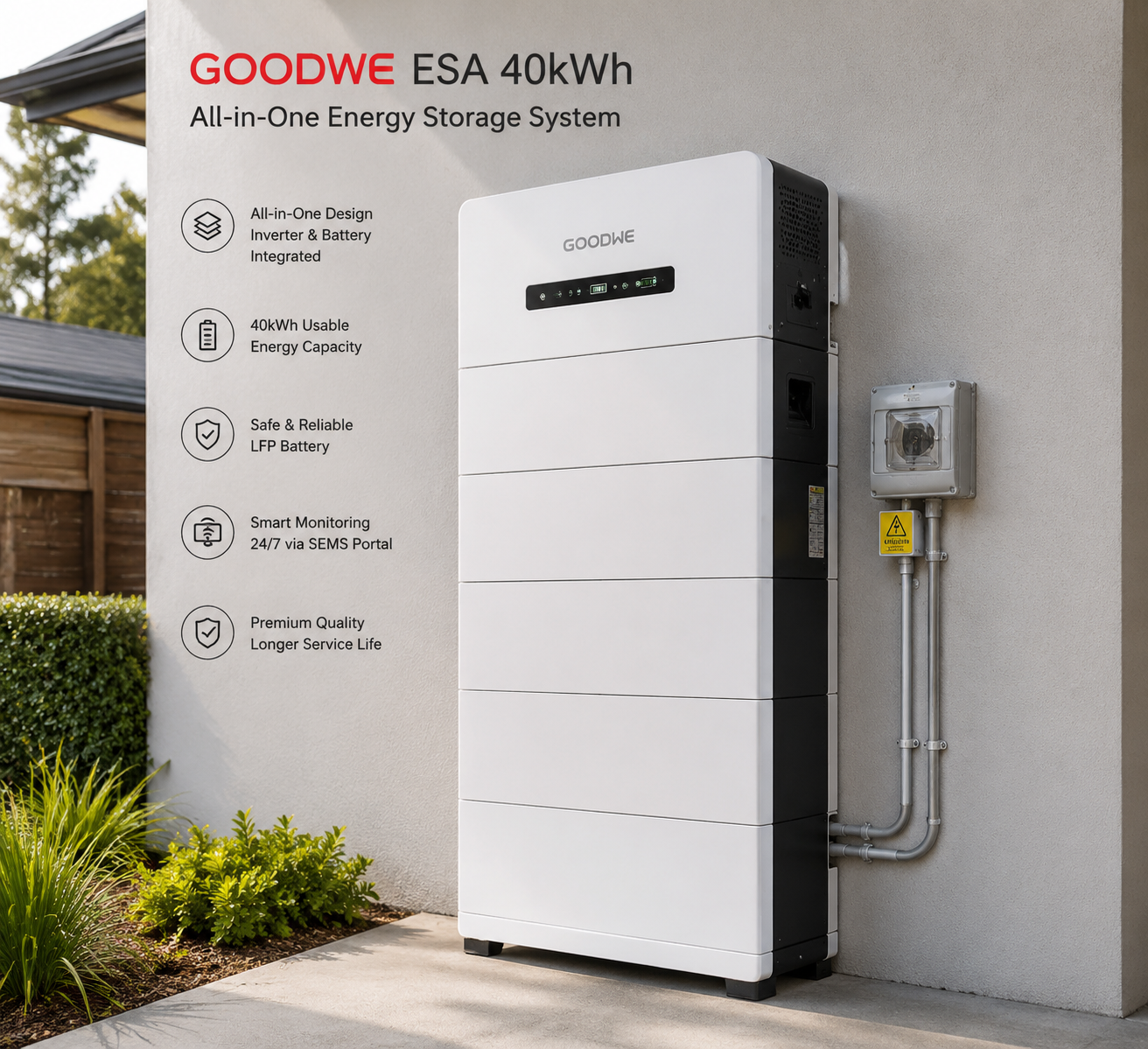
The ESA Series is GoodWe’s three-phase all-in-one energy storage platform. Instead of a hybrid inverter bolted to a separately-built battery rack, the inverter and battery modules are engineered as one pre-wired, modular system — GoodWe’s own literature describes it as unifying the inverter and battery into a single structure that streamlines installation and commissioning.
The platform scales from a 5kW/5kWh starting point right up to 30kW and 108kWh, using 5.1, 6.0, 8.3 or 9.0kWh high-voltage LFP battery modules that mix and match on the same stack. The three-phase ESA received Clean Energy Council approval in early 2026, which is what makes it eligible for the federal battery rebate alongside the existing WA state scheme.
Not sure what capacity your home actually needs? Our battery sizing guide breaks down 10–28kWh builds in more detail — this article assumes you already know you want something in the 40kWh-plus range.
Solar Red’s Featured Build: 15kW + 40kWh
This is the configuration we’re comparing against Fox ESS and Sungrow throughout this article — a genuinely large three-phase system, but every point below scales down to smaller homes too.
The Exact Build We’re Installing
GW15K-ETA-G20 three-phase inverter plus five GW8.3-BAT-D-G20 battery modules — 41.6kWh rated, 40kWh usable, ready to run a 20–25kW panel array without clipping.
The battery side: five GW8.3-BAT-D-G20 modules, each rated at 8.32kWh with 8.0kWh usable (tested at 100% depth of discharge), for 41.6kWh rated / 40kWh usable in total. At Perth’s average solar generation factor of roughly 5.3kWh per installed kW per day, that 200% oversizing headroom is genuinely useful — a 15kW inverter can comfortably run a 20–25kW array without clipping losses on long summer days.
Is It Really “All-in-One”? The Size Story
This is the detail that actually separates these three systems, and it comes straight off the datasheets rather than the marketing copy.
| System | Inverter | Battery | Form factor |
|---|---|---|---|
| GoodWe ESA | 800×340×270mm | 800×326×270mm per module | One column, matched footprint |
| Fox ESS H3 + CQ6 | 600×450×226mm, wall-mounted | 660×360×420mm per module, floor-stacked | Two separate enclosures |
| Sungrow SH15T + SBH400 | 620×480×245mm, wall-mounted | 675×1,540×350mm tower, 376kg | Two separate enclosures |
Fox ESS and Sungrow both call their systems “all-in-one” in their marketing, and in the sense that inverter and battery are matched and sold as a package, that’s fair. But only GoodWe’s components are dimensionally matched to physically stack as a single unit. If floor space and a tidy install are the priority, that’s a real, measurable difference — not just branding.
Charge, Discharge & Backup Power: The Amps That Matter
Size is one half of “all-in-one” — the other is how much power the stack can actually push, and how it handles a blackout.
Charge and discharge power
At this 15kW tier, all three inverters are matched on raw output: 15kW nominal, roughly 16.5kW peak. Size alone doesn’t separate them here — the amp ratings underneath do.
The GoodWe GW15K-ETA-G20 draws a continuous 20.1A charging / 22.1A discharging at the battery side, running at 750V nominal — that maps precisely to its 15.0kW/16.5kW power figures. Each GW8.3-BAT-D-G20 module is separately rated to 19.0A in / 21.0A out with its own DC-DC converter, and can peak at 12kW for 10 seconds per module.
Fox ESS’s H3 Smart family specs a flat 50.0A max charge/discharge current across every model from 5kW to 15kW, over a wider 100–800V battery range. On paper that’s more than double GoodWe’s continuous amp rating — but it doesn’t translate into more usable power at the 15kW tier, because the H3-15.0-Smart’s own AC output is still capped at the same 15kW/16.5kVA as the GoodWe.
Whole-home backup amps
This is where the three genuinely diverge. GoodWe’s ESA and Sungrow’s SH15T both build a 63A whole-home bypass straight into the inverter — no extra hardware, just a wired backup circuit that takes over automatically. GoodWe switches in under 4ms; Sungrow’s own material quotes roughly 10ms.
Fox ESS’s H3 Smart doesn’t ship with that internal bypass. Australian installers commonly wire an external changeover contactor — typically a 63A-rated unit — to the inverter’s EPS port to get the same whole-home coverage. It gets to a similar result, but it’s an extra component, an extra point of failure and extra labour that GoodWe and Sungrow don’t need.
| Spec | GoodWe ESA | Fox ESS H3 Smart | Sungrow SH15T |
|---|---|---|---|
| Max charge power | 15.0kW | 15.0kW | 15.0kW |
| Battery-side max current | 20.1A / 22.1A | 50.0A flat | 50A continuous |
| Whole-home backup | 63A, built-in | External ~63A contactor typical | 63A, built-in |
| Backup switchover | <4ms | Not published for AU | ~10ms |
Net result: on raw battery-side amps, Fox ESS and Sungrow’s batteries are actually specced higher than GoodWe’s. But for the thing that matters when the power goes out — a whole-home bypass that just works without extra gear — GoodWe and Sungrow have it built in, and GoodWe switches over faster than either.
How the Stack Goes Together
Full Spec Comparison
Same 15kW three-phase, ~40kWh usable class across all three brands. Figures are from each manufacturer’s current official datasheet.
Inverter (head unit)
| Spec | GoodWe GW15K-ETA-G20 | Fox ESS H3-15.0-Smart | Sungrow SH15T |
|---|---|---|---|
| Dimensions (W×H×D) | 800×340×270mm | 600×450×226mm | 620×480×245mm |
| Weight | 34kg | 34kg | 38kg |
| MPPTs | 4 | 3 | 3 |
| Max efficiency | 98.1% | up to 97.9% | 98.1% |
| European efficiency | 97.3% | 97.2% | 97.6% |
| IP rating | IP66 | IP65 | IP65 |
| Standard warranty | 10 years | 10 years | 10 years |
Battery (closest ~40kWh usable build)
| Spec | GoodWe (5×8.3kWh) | Fox ESS CQ6 (~7 modules) | Sungrow SBH400 (8×5kWh) |
|---|---|---|---|
| Rated / usable capacity | 41.6kWh / 40kWh | ~41.9kWh usable | 40kWh / 40kWh (100% DOD) |
| IP rating | IP66 | IP65 | IP55 |
| Battery warranty | 10 years, 70% retention | 12 years, 70% retention | 10 years, 70% retention |
Worth flagging on the battery current ratings: raw amp figures can be misleading without inverter context — every battery here is behind a 15kW-class inverter, so that’s the real ceiling on delivered power, not the battery’s own rating.
Perth & WA Rebates for These Systems
All three brands are CEC-approved, so rebate eligibility comes down to usable kWh and confirming the specific model is on the current approved list — not the brand you pick. Figures below last verified 15 August 2026.
Federal Cheaper Home Batteries Program
Since the 1 May 2026 step-down, tiered at roughly $252/kWh on the first 14kWh, $151/kWh from 14–28kWh, and $38/kWh from 28–50kWh. For a 40kWh usable system:
14kWh × $151 = $2,114
12kWh × $38 = $456
Total: roughly $6,100
WA Residential Battery Scheme
| Network | Rebate rate | Cap (at 10kWh) |
|---|---|---|
| Synergy | $130 per usable kWh | $1,300 |
| Horizon Power | $380 per usable kWh | $3,800 |
Stacked together, a Perth (Synergy) customer is looking at roughly $7,400 in combined rebates on this build; a Horizon Power customer in regional WA closer to $9,900. See our WA battery rebate guide for full eligibility detail.
Installation Compliance in WA
Every battery installation in Australia has to meet AS/NZS 5139, which governs placement, clearances and mechanical protection. For a garage or carport install where a vehicle could reasonably strike the unit, that usually means a physical barrier — a surface-mounted safety bollard is the standard fix, included as standard where the site calls for it.
The Verdict: Which One Wins?
GoodWe ESA All-in-One Wins on Size, Form Factor & Spec
It’s the only one of the three where the inverter and battery genuinely share a footprint and stack as one column instead of two separate enclosures. It also ties for the highest inverter efficiency, has the most MPPTs, the fastest backup switchover and the highest IP rating.
To be fair to the other two: Fox ESS’s newest CQ6 battery carries a 12-year warranty against GoodWe’s 10. Sungrow’s SBH battery rates 100% usable capacity with no rated-to-usable derate, and posts a slightly higher European efficiency. But for a Perth home where floor space, a clean single-trade install and top-tier specs all matter, the GoodWe ESA All-in-One is the strongest all-round pick of the three — which is exactly why it’s the system we’re building out across our current Perth jobs.
Get a GoodWe ESA quote built around your home
We size the inverter and battery stack to your actual roof and usage, not a generic package.
Get a free quoteExplore More Solar Red Guides
Frequently Asked Questions
- Is the GoodWe ESA a good battery for Perth homes?
- Yes. It’s CEC-approved, carries a 10-year product and performance warranty, and its single-column design suits the tight garage and alfresco spaces common in Perth homes better than a two-box inverter-plus-battery setup.
- How much does a GoodWe ESA All-in-One system cost in WA?
- Industry-reported pricing sits around $955 per usable kWh before rebates, though actual cost depends on inverter size, number of battery modules and installation complexity.
- Is GoodWe ESA better than Fox ESS or Sungrow?
- On size and form factor, yes — it’s the only true single-column all-in-one of the three. On raw spec it ties or leads in most categories, though Fox ESS’s CQ6 battery has a longer warranty and Sungrow’s SBH battery has a slightly higher usable-capacity rating.
- How many battery modules can the GoodWe ESA All-in-One take?
- Up to 12 modules total (108kWh with 9kWh modules), with a maximum of 6 modules in a single stacked column.
- Is GoodWe ESA as powerful as Fox ESS on charge and discharge?
- At this 15kW tier, all three brands are matched on delivered power. Fox ESS and Sungrow spec higher raw battery-side amperage, but that headroom doesn’t convert into more usable power once the inverter’s own AC rating is the limiting factor.
- Does the GoodWe ESA qualify for the WA and federal battery rebates?
- Yes, provided the specific model is on the current Synergy or Horizon Power Supported Solutions list and the install meets VPP enrolment requirements for the WA scheme. Both rebates stack.