In this guide
The ALP vs APX Lineup
Growatt runs two separate residential battery lines, and which one you end up with depends on your inverter phase, not just preference:
ALP — low voltage, single phase
- 5.0kWh modules (ALP5.0L-E1), 51.2V nominal, stackable 5–40kWh
- 92% depth of discharge — 4.6kWh usable per module
- Pairs exclusively with Growatt’s single-phase hybrids (SPH, SPM, SPF series)
APX — high voltage, three phase
- 5.0kWh modules (APX 5.0P-B1), 385V nominal, stackable 5–60kWh+
- Module-level DC-DC optimisation, mixes old and new modules in one system
- Pairs with Growatt’s three-phase hybrids (MOD XH, MID XH series)
Both use cobalt-free LFP cells, carry a 10-year warranty, and are IP66-rated for outdoor mounting. For a broader rundown of where Growatt sits against our other five brands, see our battery brand comparison guide.
Why 40kWh Is Always Two Stacks
This is the detail that trips people up when they see “40kWh” quoted as a single number: neither Growatt battery line puts that much energy in one column.
| Battery | Max modules per stack | Max capacity per stack | Modules for 40kWh |
|---|---|---|---|
| ALP 5.0L-E1 | 6 | 30kWh | 8 modules — two stacks |
| APX 5.0P-B1 | 4–6 (inverter dependent) | 20–30kWh | 8 modules — two stacks |
Single Phase: ALP + Inverter
For a 40kWh ALP build (8 modules, two stacks of 4), Growatt documents two real inverter pairings:
SPH 5000/6000TL-HUB — the all-in-one option
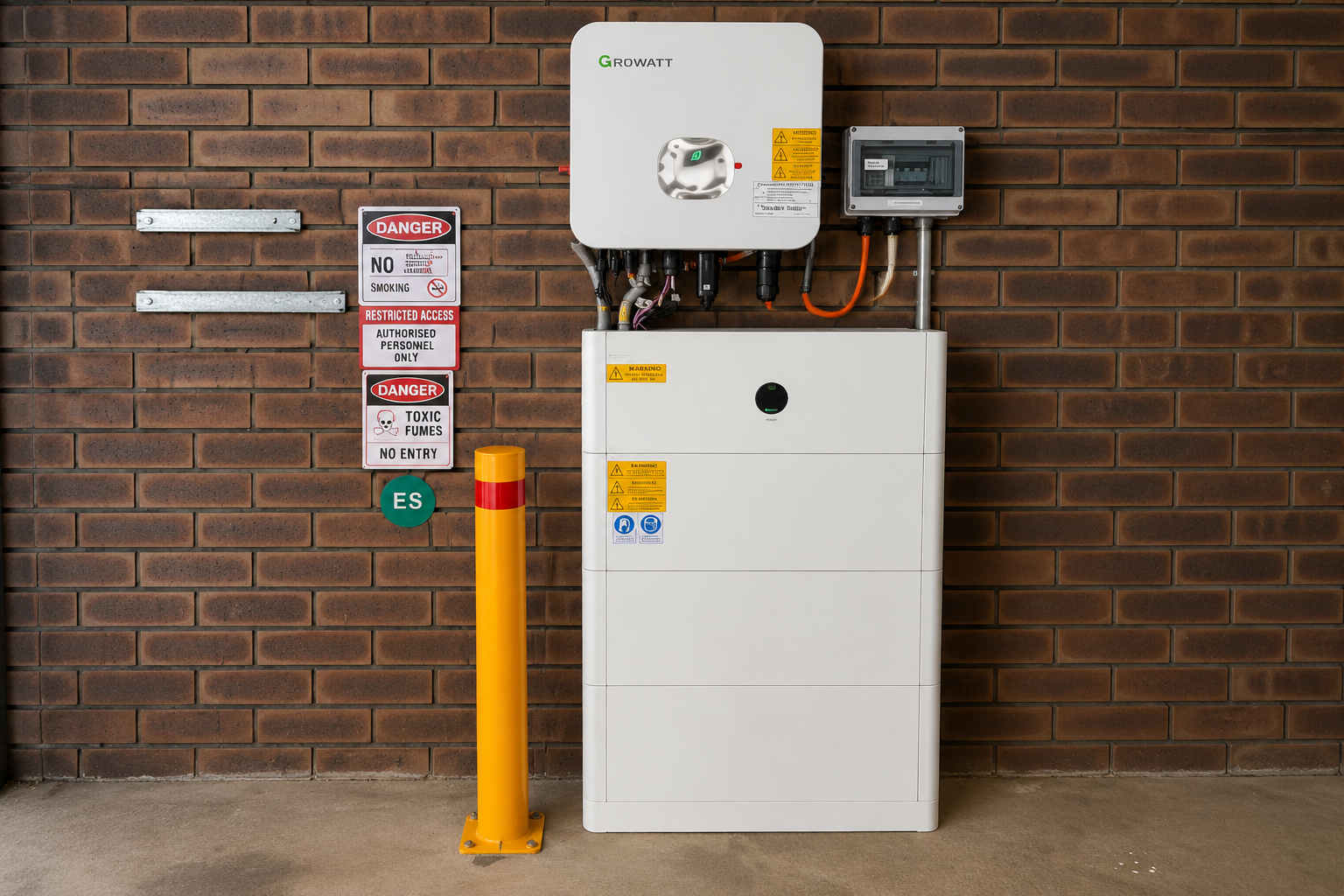
The compact choice: inverter and battery base are designed to be installed together as one physical unit. 5000–6000W AC output, matching backup apparent power, 10-year warranty.
The catch: a 6kW inverter on a 40kWh battery takes a long time to fully cycle — over 6 hours to charge from empty even at full rate. If you want the battery to actually move that much energy in a reasonable window, Growatt’s other documented path is the SPM 8000-10000TL-HU, which reaches a genuine 10kW charge/discharge rate at this capacity — but it needs two upgraded ALP 5.0L-E2 “master” modules (one per stack) alongside the standard E1 modules to do it.
| Spec | SPH 5000/6000TL-HUB | SPM 8000-10000TL-HU |
|---|---|---|
| AC output | 5–6kW | Up to 10kW |
| Charge/discharge rate at 40kWh | 5–6kW | 10kW (needs 2× ALP 5.0L-E2) |
| Form factor | All-in-one, mounts with battery | Separate wall-mounted inverter |
| Battery modules (40kWh) | 8× ALP5.0L-E1, 2 stacks | 6× ALP5.0L-E1 + 2× ALP5.0L-E2, 2 stacks |
Three Phase: APX + the MID 10kW Inverter
Here’s the correction worth knowing before you order: the Growatt MOD 5000-10000TL3-XH family (the “10kW MOD” a lot of people reach for) only supports APX battery capacity up to 30kWh per Growatt’s own configuration tables. Push past that and it’s not rated for it.
For 40kWh, the inverter you actually want is the MID 10K-30K TL3-XH
Same “10kW” starting point, but a different inverter family — the MID range is what Growatt documents as scaling up to 60kWh with APX. At the 35–40kWh tier specifically, that’s 7–8 APX 5.0P-B1 modules across two columns, each with its own APX Power Module (BMS).
The 40kWh Three-Phase Build
Growatt MID 10K-30K TL3-XH plus 8× APX 5.0P-B1 modules across two stacks, each with its own APX 98034-P2 Power Module.
Each APX Power Module (the “master” unit each stack needs) is rated to 15kW max output on its own — more than the inverter’s per-battery-port rating needs, similar to the headroom we’ve seen on other brands’ battery-side electronics.
Whole-Home Backup on Three Phase
Worth flagging since it’s easy to assume backup is automatic: the MOD and MID XH inverters don’t include whole-home backup switching by default. Growatt’s accessory for that is the SYN100-XH-30 backup box, rated to 40kW, compatible with both the MOD XH and MID XH families. It’s a genuine extra line item on the quote, not something bundled into the inverter price.
Full Spec Comparison
Battery modules
| Spec | ALP 5.0L-E1 | APX 5.0P-B1 |
|---|---|---|
| Nominal / usable capacity | 5.0kWh / 4.6kWh (92% DOD) | 5.0kWh (module-level optimised) |
| Nominal voltage | 51.2V | 385V |
| Rated / max current | 75A / 90A | Set by Power Module (26A / 34A) |
| Dimensions | 690×185×295mm | 690×185×295mm |
| Weight | 44kg | ~50kg |
| IP rating | IP66 | IP66 |
| Max per stack | 6 modules (30kWh) | 4–6 modules (20–30kWh) |
| Warranty | 10 years | 10 years |
Inverters
| Spec | SPH 6000TL-HUB | SPM 10000TL-HU | MID 10kW TL3-XH |
|---|---|---|---|
| Phase | Single | Single | Three |
| AC output | 6kW | 10kW | 10kW |
| Max efficiency | ~97.6% | Not published | ~98.6% |
| MPPTs | 2 | Not published | 2 |
| Whole-home backup | Built-in | Built-in | External SYN100-XH-30 required |
| Compatible battery | ALP only | ALP only | APX (or ARK XH) |
Perth & WA Rebates for These Systems
Rebate eligibility runs on usable kWh, so the ALP and APX builds land at slightly different numbers even at the same “40kWh” nominal size. Figures last verified 15 August 2026.
Federal Cheaper Home Batteries Program (ALP example, 36.8kWh usable)
14kWh × $151 = $2,114
8.8kWh × $38 = $334
Total: roughly $5,976
For the APX build, run the same tiered calculation against its usable capacity once confirmed at quote stage — the mechanism is identical, only the input number changes.
WA Residential Battery Scheme
Capped at 10kWh regardless of actual battery size: $130/kWh up to $1,300 for Synergy customers, $380/kWh up to $3,800 for Horizon Power customers — the same flat cap applies to both the ALP and APX builds. See our WA battery rebate guide for full eligibility detail.
Installation Compliance in WA
AS/NZS 5139 governs placement, clearances and mechanical protection for every battery install. With two stacks instead of one, floor planning matters more than usual — each stack needs its own clearance plus the 500–600mm gap between them, and Growatt specifies a floor load rating of at least 300kg under a full 6-module column.
Which One to Pick
Choose ALP if: you’re single phase
It’s the only Growatt battery that pairs with single-phase hybrids. The SPH HUB keeps the footprint tightest; the SPM 10kW is the better-matched power option for a battery this size.
Choose APX if: you’re three phase
Just make sure the quote says MID, not MOD, once you’re past 30kWh — that’s the detail that actually determines whether the inverter can run the full 40kWh.
Get a Growatt quote matched to your phase and roof
We confirm the correct inverter family before it goes on the quote, not after.
Get a free quoteExplore More Solar Red Guides
Frequently Asked Questions
- Why does a 40kWh Growatt battery need two stacks?
- Both Growatt battery lines cap out below 40kWh per column: ALP allows a maximum of 6 modules per stack, and APX a maximum of 4 to 6 depending on the inverter pairing. A 40kWh build uses 8 modules of either battery, which exceeds a single column’s limit in both cases, so it’s always split into two stacks.
- What inverter pairs with a 40kWh Growatt ALP battery?
- Growatt’s documented path to 25-40kWh with ALP is the SPH 5000/6000TL-HUB all-in-one inverter, or the SPM 8000-10000TL-HU for a higher 10kW charge/discharge rate, which needs two upgraded ALP 5.0L-E2 master modules.
- Is the Growatt MOD 10kW inverter right for a 40kWh APX battery?
- No. Growatt’s MOD 5000-10000TL3-XH family only supports APX battery capacity up to 30kWh. For 40kWh, the correct pairing is the MID 10K-30K TL3-XH, which supports APX capacity up to 60kWh.
- Does a Growatt three-phase system need extra hardware for whole-home backup?
- Yes. The MOD and MID XH inverters need the separate SYN100-XH-30 backup box, rated to 40kW, to provide whole-home backup power during an outage.
- Does a 40kWh Growatt system qualify for WA and federal battery rebates?
- Yes, provided the specific model is on the current Synergy or Horizon Power Supported Solutions list and the install meets VPP enrolment requirements. Both rebates stack.